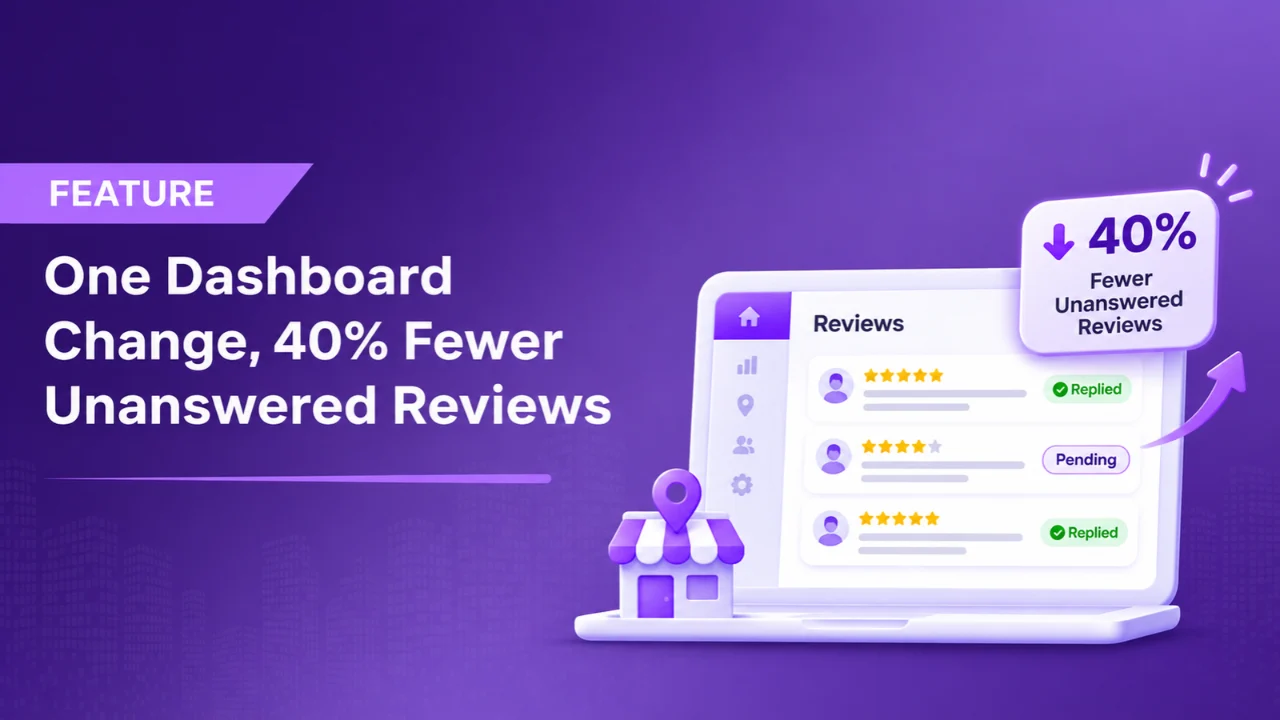
One Dashboard Change, 40% Fewer Unanswered Reviews – What We Did
Managing customer reviews across multiple locations can quickly become challenging, leading to missed feedback and delayed responses. A single, centralized dashboard can make review management faster, simpler, and more consistent.
Published on:
Updated on:
Published on:
Last Updated on:
Blog
Summary
Unable to load the audio. Please check the audio file URL.
Managing customer reviews sounds simple when a business has only one location. A few new reviews come in, someone checks them, and responses are posted whenever time allows.
But things change when a business operates multiple outlets. Reviews start coming from different locations, managers have separate responsibilities, and customer feedback gets scattered across several Google Business Profiles. Some reviews receive quick responses, while others remain unanswered for days.
This creates a problem that many growing businesses overlook. Customers are sharing their experiences, but the business is not responding consistently.
We looked at this challenge from a different perspective: instead of asking businesses to spend more time managing reviews, what if we made the entire process easier to handle?
Bring all reviews into one dashboard, make responses easier, and give teams a clear view of what needs attention.
The target outcome was a 40% reduction in unanswered reviews.
Here’s what we changed and why it matters.
1. The Problem: Reviews Were Coming In, But Responses Were Falling Behind
For businesses with multiple outlets, managing Google reviews manually can quickly become difficult.
Imagine a business operating 15 locations. Each location has its own Google Business Profile, receives customer feedback, and needs regular attention.
The team might have to:
- Open different Google Business Profiles to check new reviews.
- Remember which locations have pending responses.
- Coordinate with individual branch managers.
- Write responses manually for every customer.
- Check whether negative feedback has been addressed.
- Maintain a consistent communication style across all outlets.
Even when a business has a dedicated marketing team, these activities consume considerable time.
The bigger issue is that there is no clear picture of the overall situation. A manager might know that one outlet has responded to every review but may not realise that another location has several unanswered customer complaints.
As the number of locations increases, the chances of missing reviews also increase.
We realised that the problem was not necessarily a lack of effort. It was the absence of a centralised process.
2. What We Changed: One Dashboard Instead of Multiple Logins
Our first step was to simplify how teams accessed and managed customer reviews.
Instead of checking each business profile separately, we brought review activity from multiple locations into one centralised dashboard.
This changed how the team approached daily review management.
Now, instead of switching between accounts, team members could view customer feedback from different locations in one place.
Everything in One Place
- View incoming reviews across all connected locations.
- Identify which reviews are still unanswered.
- Check customer ratings and feedback.
- Manage responses from a single interface.
- Monitor review activity location-wise.
- Maintain better control over daily review management.
The biggest improvement was visibility.
When everything is available in one place, managers no longer need to depend on individual updates from every branch to understand what is happening.
They can identify pending work, prioritise important feedback, and make sure customers are not being overlooked.
Sometimes, improving a business process does not require adding more people. It requires giving existing people better tools.
3. Making Review Responses Faster With AI
Centralising reviews solved the visibility problem, but another challenge remained: writing responses.
A personalised response takes time, especially when a business receives dozens or hundreds of reviews every month.
Copying and pasting the same response for every customer is not a good solution either. Customers appreciate responses that acknowledge their actual experience.
This is where AI-powered response suggestions became useful.
We introduced a system that helps businesses generate relevant responses based on the review content and star rating.
How Should a Business Respond?
Select a customer review type to see how a thoughtful response can be written.
Thank you for your kind words! We’re glad you had a great experience with our team. Your feedback means a lot to us, and we look forward to welcoming you again.
For example, a positive customer review appreciating staff behaviour should receive a response that acknowledges the customer’s appreciation and welcomes them back.
Similarly, a negative review about delayed service should receive a response that acknowledges the concern, expresses genuine regret, and encourages the customer to connect with the business for further assistance.
The objective is not to replace human communication. It is to reduce the time spent writing repetitive responses while maintaining a natural tone.
Businesses can configure their preferred response style, use AI-generated suggestions, and retain the option to review or edit responses before publishing.
This makes it easier for teams to respond consistently without spending unnecessary time on every individual reply.
4. Giving Every Location Clear Responsibility
Another important change was improving accountability.
When multiple people manage different business locations, it is easy for responsibilities to become unclear.
A regional manager might assume that the branch manager is handling reviews. The branch manager might assume that the central marketing team is responsible.
Meanwhile, customer feedback continues to arrive.
A centralised dashboard makes it easier to establish a clear workflow.
Who Should Manage What?
Central Marketing Team: Monitors overall review activity and response consistency.
Regional Managers: Check performance across their assigned locations.
Branch Managers: Focus on customer feedback relevant to their outlets.
Business Management: Reviews overall performance and identifies operational issues.
This structure helps businesses avoid confusion and ensures that important feedback reaches the right people.
It also makes it easier to identify locations that need additional attention.
A branch receiving several negative reviews, for instance, may need operational improvements rather than simply faster responses.
Customer feedback should help businesses improve their services, not just maintain their online reputation.
5. Why a 40% Reduction in Unanswered Reviews Matters
Reducing unanswered reviews by 40% is more than an improvement in a dashboard metric. It represents a better way of managing customer communication.
Consider a business that receives 100 reviews in a particular reporting period. If 30 remain unanswered, that means 30 customer interactions have been missed.
A 40% reduction in those unanswered reviews would bring the number down from 30 to 18.
That means 12 additional customer reviews receive attention.
Calculate Your Unanswered Reviews
Enter your review numbers to understand how a 40% reduction could change your response workload.
12 additional reviews could receive responses.
Illustrative calculation based on a 40% reduction in unanswered reviews, not a guaranteed business result.
While the calculation is straightforward, the business impact can be meaningful.
Better Customer Relationships
Customers can see that the business takes their feedback seriously. A thoughtful response can make customers feel heard, even when their experience was not ideal.
Improved Brand Perception
Consistent communication creates a more professional impression and helps businesses maintain a reliable online presence.
Faster Issue Identification
Negative reviews become easier to identify and forward to the relevant teams. This helps businesses recognise recurring service problems.
Better Management Visibility
Business owners can understand which locations are performing well and which need improvement.
Less Manual Effort
Employees spend less time checking multiple profiles and writing repetitive responses.
It is important to remember that responding to reviews does not automatically guarantee higher ratings or better search rankings. However, regular engagement is an important part of maintaining a trustworthy business presence online.
6. Why This Becomes More Important as a Business Grows
The review management process that works for a single outlet may not work for a business with 20 or 50 locations.
At a smaller scale, one person can probably manage everything manually. But as the number of locations increases, the workload becomes difficult to maintain.
This is where a centralised approach becomes valuable.
A well-organised review management system should help businesses:
- Monitor reviews from every location.
- Maintain consistent response standards.
- Identify recurring customer complaints.
- Compare customer sentiment across outlets.
- Track review growth and ratings.
- Keep business information and profiles updated.
These activities also contribute to a stronger Local SEO strategy.
When customers search for nearby products or services, they often compare businesses based on ratings, reviews, location information, and the overall quality of their online presence.
Businesses that actively manage these areas are better positioned to build customer confidence and maintain a competitive presence in local search results.
For growing brands, having a dedicated Local SEO for Multi-Location Business strategy can make it easier to maintain consistency while addressing the unique needs of individual locations.
7. How Revplies Helps Businesses Manage Reviews Better
At Revplies, we built our platform around a simple idea: managing online reputation should not become another complicated responsibility for business owners.
Instead of relying on separate accounts, spreadsheets, and manual follow-ups, businesses can manage their Google Business Profiles through one centralised platform.
Centralised Review Management
View and manage customer reviews across multiple locations without constantly switching between accounts.
AI-Powered Review Replies
Generate personalised response suggestions based on customer feedback and preferred communication style.
Automatic Reply Settings
Configure response rules to reduce manual work while retaining control over how reviews are handled.
Review Analytics
Monitor review trends, ratings, and customer sentiment to understand how customers feel about different locations.
Location Grouping
Organise similar outlets or business locations into groups for easier management and reporting.
Performance Monitoring
Understand how individual locations are performing and identify areas that require attention.
The goal is to give business owners and marketing teams a clearer picture of their online reputation while reducing the effort required to maintain it.
8. The Bigger Lesson: Better Systems Create Better Consistency
One important lesson from this approach is that customer review management should not depend entirely on someone’s memory or availability.
When the process is manual, even a hardworking team can miss important tasks. Reviews get delayed, responsibilities become unclear, and some locations receive more attention than others.
A centralised dashboard creates a more organised working environment.
It gives teams visibility, simplifies communication, and makes it easier to take action when customers share their experiences.
The 40% reduction in unanswered reviews is a useful way to understand the potential impact of improving the process. But the bigger objective is to build a system that continues working as the business grows.
Because every customer review represents an opportunity to understand your customers, address their concerns, and build stronger relationships.
And no business should miss that opportunity simply because managing reviews has become too complicated.
Frequently Asked Questions
Why should businesses respond to Google reviews?
Responding to reviews shows customers that their feedback matters. It also gives businesses an opportunity to acknowledge positive experiences, address complaints, and maintain professional communication.
How can businesses manage reviews across multiple locations?
A centralised review management dashboard can bring feedback from multiple Google Business Profiles into one place. Teams can monitor pending reviews, manage responses, and track individual location performance more efficiently.
Can AI automatically write Google review replies?
AI tools can generate personalised response suggestions based on review content and star ratings. Businesses can use these suggestions to save time while maintaining their preferred communication style and reviewing responses before publishing.
Does responding to Google reviews improve local rankings?
Responding to reviews is one aspect of maintaining an active and trustworthy business presence. However, it does not guarantee improved rankings. Search visibility also depends on relevance, distance, prominence, and other factors.
What is the benefit of a centralised review dashboard?
It helps businesses monitor reviews across different locations, identify unanswered feedback, improve team accountability, and reduce the time spent switching between individual business profiles.
Ready to Manage Your Reviews Better?
Stop switching between multiple profiles and start managing customer feedback from one place.
Get Your Free Audit →
Recent Blogs
-
One Dashboard Change, 40% Fewer Unanswered Reviews #2
The 60-Second Google Business Profile Health Check Every Owner Should…
-
How 12 Locations Reached the Google Map Pack
How a 12-Location Chain Went From Page 2 to the…