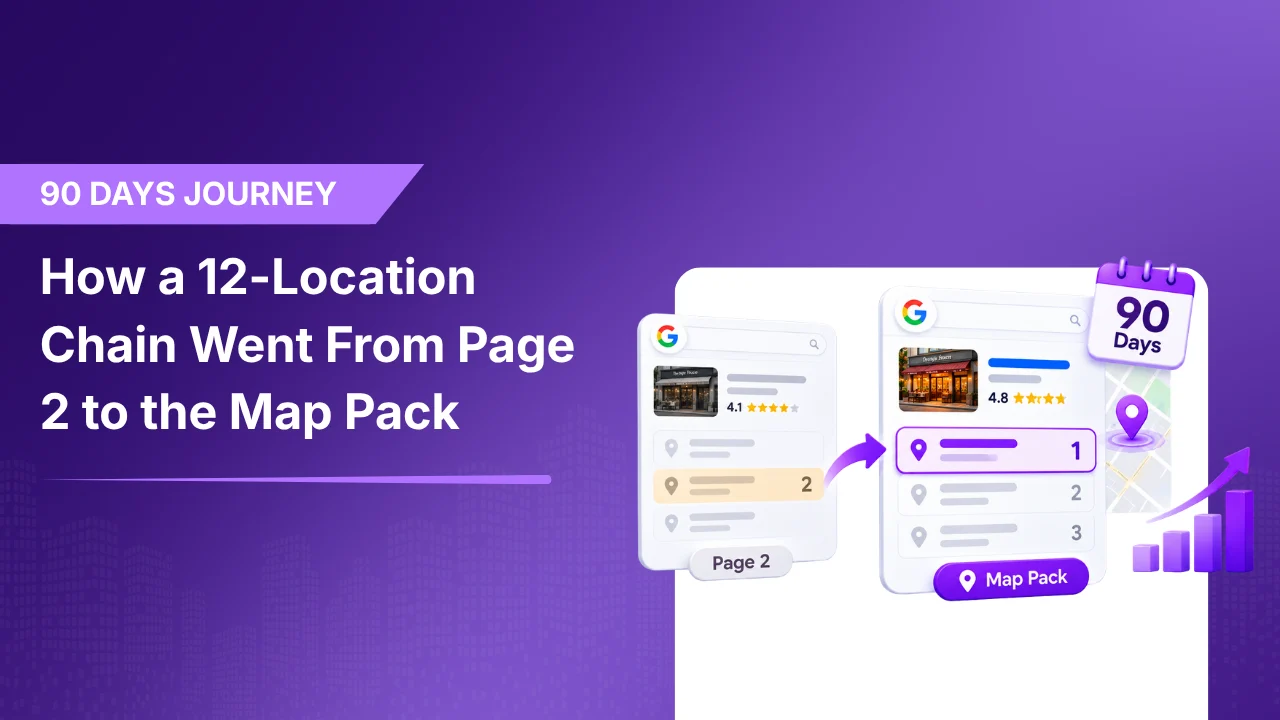
How a 12-Location Chain Went From Page 2 to the Map Pack in 90 Days
How can 12 business locations move from page two to the Google Maps Map Pack in 90 days? This case study explores the local SEO strategies, competitor analysis, and review management tactics that can improve visibility and attract more local customers.
Published on:
Updated on:
Published on:
Last Updated on:
Blog
Summary
Unable to load the audio. Please check the audio file URL.
A business can operate 12 locations, maintain 12 Google Business Profiles, and still struggle to appear where local customers are looking.
The problem is not always a lack of SEO activity. Sometimes, the problem is that the activity is not addressing the reasons individual locations fail to compete.
That was the challenge behind our 12-location local SEO case study: move locations struggling on page two toward meaningful visibility in the Google Maps local results within 90 days.
The objective was not to publish more Google Business Profile posts or collect reviews indiscriminately. It was to identify location-specific ranking gaps, prioritize the opportunities with the greatest potential, and measure whether the changes improved visibility.
Here is how we approached the problem.
Every location has a different ranking gap
Track the same priority service and local queries for each branch. Record where each location appears before making changes, then compare results using the same method.
This is a diagnostic framework, not a report of measured results for the 12 locations.
1. Why All 12 Locations Could Not Share One SEO Strategy
The first mistake many multi-location businesses make is treating every branch as a copy of the same business.
They use similar descriptions, follow identical posting schedules, and apply the same optimization checklist to every profile. Operationally, this looks efficient. Strategically, it can overlook the differences that determine local competitiveness.
One location might have accurate business information but weak review coverage. Another might have a strong reputation but compete against established businesses with better local relevance. A third might have a well-optimized profile but struggle because the searcher is outside its strongest geographic area.
These are different problems. They require different responses.
We approached the 12 locations as separate local search markets connected by one brand not as 12 identical listings.
This distinction matters because Google’s local results are primarily influenced by relevance, distance, and prominence. Improving one factor does not guarantee a higher position, particularly when distance and competitor strength vary.
2. The First Step Was Measuring Visibility at the Location Level
Before changing profiles, we needed a reliable baseline.
A manual Google search was not sufficient. Local results can vary according to the searcher’s location, the query, and the competitive environment. Checking a business from its office computer can create a misleading impression of how visible it is to customers elsewhere in its service area.
We therefore treated local rank tracking as a diagnostic exercise.
For each location, the audit needed to establish:
- Keyword visibility: Where did the business appear for its primary service and relevant local searches?
- Geographic coverage: Did visibility remain strong around the business, or deteriorate just a short distance away?
- Profile completeness: Were categories, services, contact information, hours, and website links accurate?
- Reputation strength: How did review volume, recency, rating, and response practices compare with relevant competitors?
- Website relevance: Did the corresponding location page clearly communicate the services and location it was intended to support?
The important decision was to evaluate these signals together.
A location ranking poorly across a broad geographic area may need a different intervention from one ranking well nearby but losing visibility farther away.
This is why we recommend a structured Local SEO audit and rank checker before investing time in another round of routine optimization.
3. We Prioritized Gaps Instead of Applying a Generic Checklist
Once the baseline was established, the next question was not, “What can we optimize?”
It was, “Which weakness is most likely to be limiting this location’s competitiveness?”
That distinction changed how the work was prioritized.
Correcting business information and profile gaps
We reviewed core profile information, including primary categories, business hours, contact details, services, and website destinations.
We also checked whether each profile pointed to the appropriate location page rather than sending every potential customer to the corporate homepage.
These corrections help establish consistency and make it easier for customers and search systems to understand each business location. They are important foundations, although they do not independently guarantee ranking improvements.
Improving location-page relevance
A Google Business Profile should connect to a website that supports the same local intent.
For each branch, we assessed whether its location page communicated the actual services offered, the correct address and contact information, relevant customer information, and a clear next step.
The objective was not to create 12 near-identical pages with different city names. It was to make each page genuinely useful for customers choosing that particular location.
Addressing local competition
We compared the businesses appearing ahead of each branch for relevant searches.
This helped us distinguish between gaps that could be addressed through better business information, stronger website relevance, and more consistent reputation management, and challenges that might require a longer-term strategy.
We did not assume that every competitor ranking above a location was doing everything better. Instead, we looked for specific, observable differences worth investigating.
4. Reviews Became a Reputation Management Process, Not a Numbers Game
Reviews are an important part of local business reputation. But simply increasing the total number of reviews is not a complete local SEO strategy.
A location may have hundreds of reviews and still struggle to rank for a particular query. Another may have fewer reviews but stronger relevance to the search, a more favorable geographic position, or a different competitive environment.
Our approach focused on making review management consistent across the chain.
That meant identifying locations with weak review activity, making it easier for genuine customers to leave feedback, monitoring incoming reviews, and ensuring responses were handled promptly and appropriately.
We also treated review content as a source of operational insight. Recurring complaints about service delays, communication, or customer experience can reveal problems that reputation management alone cannot solve.
There is an important distinction here: businesses should ask customers for honest feedback without incentivizing positive reviews or directing customers to include ranking keywords.
The objective is to improve the customer experience and build a trustworthy reputation not manufacture signals for a search algorithm.
For a chain operating multiple branches, centralized review monitoring helps maintain oversight while allowing each location’s customer experience to be evaluated separately.
Three phases. One measurement process.
Days 1–30: Diagnose and establish the baseline
Audit all 12 locations, map keyword visibility, review competitor profiles, identify website and profile inconsistencies, and document the highest-priority gaps. Set a consistent tracking baseline.
A 90-day plan is an evaluation window, not a guaranteed ranking deadline.
5. The 90-Day Execution Plan
We organized the work into three phases. The purpose was to establish a baseline, implement prioritized changes, and determine which improvements corresponded with measurable progress.
Days 1–30: Diagnose and establish the baseline
The initial phase focused on auditing all 12 locations, mapping keyword visibility, reviewing competitor profiles, identifying website and profile inconsistencies, and documenting the most important gaps.
We established a consistent tracking process so that later comparisons would use the same keywords, geographic points, and measurement approach wherever possible.
Without this baseline, it would be difficult to distinguish genuine improvement from normal fluctuations in local search results.
Days 31–60: Implement location-specific improvements
The second phase focused on executing the highest-priority corrections.
Depending on the findings, this included improving profile accuracy, refining relevant categories and services, strengthening location pages, addressing inconsistent business information, and improving review monitoring and response workflows.
We also avoided treating every branch as equally urgent. Locations with clear, correctable weaknesses could be addressed first, while locations facing stronger geographic or competitive constraints required more sustained work.
Days 61–90: Validate, compare, and refine
The final phase focused on measurement rather than simply completing the checklist.
We compared local ranking grids with the baseline, reviewed changes in Google Business Profile interactions, and investigated locations that improved less than expected.
Where visibility improved but customer actions did not, the next investigation shifted toward profile engagement, website experience, and conversion friction.
This distinction matters because a ranking report tells you where a business appears not whether that visibility generates qualified leads.
6. How We Would Measure Whether the Strategy Worked
A credible multi-location local SEO case study should report more than a change in ranking position.
We would evaluate the results using four groups of metrics:
| Measurement | What it reveals |
|---|---|
| Map Pack visibility | Whether locations appear more consistently for targeted local searches |
| Geographic ranking coverage | Whether visibility improves across the tracked area, not just at one point |
| Google Business Profile actions | Whether calls, website clicks, and direction requests change |
| Business outcomes | Whether qualified enquiries, bookings, or attributable revenue improve |
We would also compare results location by location.
A chain-wide average can conceal an important problem: a few strong locations may improve significantly while several others remain nearly invisible.
For that reason, our reporting would show how many locations improved, how many reached the targeted visibility threshold, which locations remained constrained, and what should happen next.
For a deeper breakdown, see our guide to Local SEO metrics that actually matter.
Rankings are only one part of the result
Map Pack visibility
Shows whether locations appear more consistently for targeted local searches. A ranking position alone does not show whether visibility generated customer actions.
7. What This Case Study Teaches Multi-Location Businesses
The most important lesson is that multi-location local SEO requires more than consistent execution. It requires consistent measurement combined with location-specific decisions.
A centralized workflow helps teams manage profiles, monitor reviews, and maintain oversight. But the strategy still needs to account for differences in competition, geographic coverage, website relevance, and customer reputation.
Businesses should also review the accuracy of their names, addresses, phone numbers, and location-specific links across relevant directories. Our NAP consistency guide explains how these inconsistencies can complicate local SEO management.
For businesses managing multiple branches, Revplies’ multi-location SEO platform brings profile management, review workflows, performance insights, and local rank tracking into a more coordinated process.
The benefit is not that software guarantees a Map Pack position. It is that teams can identify problems earlier, compare locations more systematically, and make decisions based on evidence rather than assumptions.
Final Takeaway
Moving a 12-location chain from page two toward the Google Maps Map Pack is not a matter of repeating the same optimization checklist 12 times.
It requires understanding why each location is underperforming, prioritizing the gaps that can realistically be addressed, and tracking whether the changes improve local visibility and customer actions.
Ninety days provides a useful period for structured execution and evaluation, but it is not a guaranteed ranking deadline. Outcomes depend on the starting position, competition, geography, implementation quality, and other factors.
The right question is not simply whether a business ranks higher today.
It is whether the business has built a repeatable process for identifying local visibility gaps, correcting them, and measuring what happens next.
Start by measuring your actual local visibility. Use the Revplies Free Local SEO Audit to investigate ranking gaps and identify opportunities for improvement across your business locations.

Recent Blogs
-
Why You’re Losing to Competitors
Every Month Your GBP Sits Outdated, Here’s What You’re Losing…
-
Google Search Console Multimodal Search
Google Search Console’s New Multimodal Search Data: What It Means…