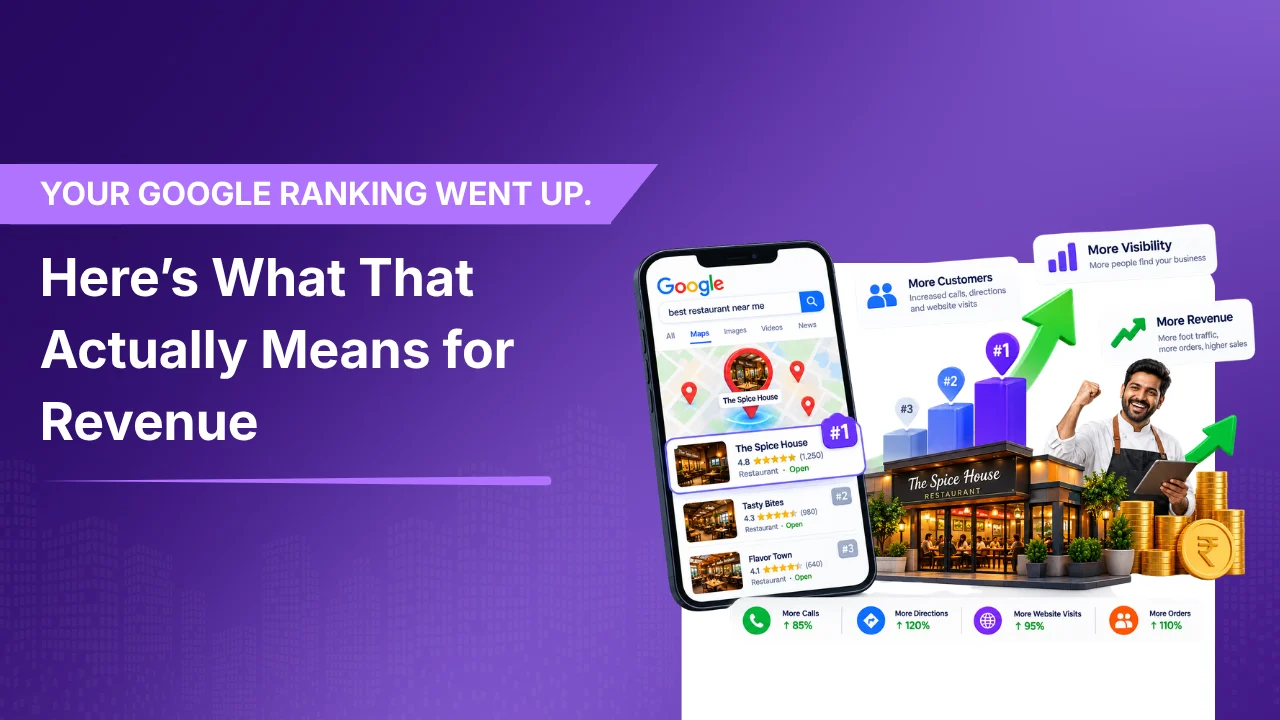
Your Google Ranking Went Up. Here’s What That Actually Means for Revenue
A higher ranking can increase visibility. But the business impact happens much further down the funnel.
Published on:
Updated on:
Published on:
Last Updated on:
Blog
Summary
Unable to load the audio. Please check the audio file URL.
Your keyword position moved from 8th to 3rd and the organic traffic increased and even the Search Console is showing green arrows everywhere but what the question arise:
And suddenly, the answer isn’t so obvious.
Ranking higher on Google can increase your visibility, click and even conversions. But ranking only doesn’t prove that SEO created more business.
The value of an SEO improvement depends on what you ranked for, who clicked, what they did after arriving, and whether those visitors eventually became potential customers.
So most businesses start celebrating after seeing a 40% increase in organic traffic while seeing almost no change in their revenue while other businesses are more focused towards revenue substantially without seeing dramatic change in their organic traffic.
Follow the value beyond the ranking
Click each stage to see where SEO can gain or lose business value.
1. A Higher Ranking Is Not the Same as Higher Revenue
For the SEO work, reporting often starts and ends with rankings. A Change of position in the keyword doesn’t guarantee new opportunity; these are only the search visibility metrics but the Revenue happens much further down the chain.
Every step can change the final outcome.
Consider two keywords.
| Keyword | Position Change | Search Intent | Traffic | Potential Business Value |
|---|---|---|---|---|
| “what is reputation management” | #9 → #3 | Informational | High | Potentially limited |
| “reputation management software” | #8 → #3 | Commercial | Lower | Potentially much higher |
The first keyword only intends to deliver information to those who are looking to gain some knowledge and the second keyword may bring visitors but people who are already evaluating a product or service.
So if the first keyword brings 5000 new visitors and the second generates only 500, it would be a mistake to automatically conclude that the first brings more value.
This is why we don’t look at ranking changes in isolation.
We ask:
- Which keywords moved?
- Which pages moved?
- What was the search intent?
- Did non-branded visibility increase?
- Did qualified traffic increase?
- Did conversions change?
- Did those conversions become customers?
The ranking is the beginning of the analysis, not the conclusion.
2. The Ranking That Matters Is the One That Changes Customer Behaviour
Not every position change creates the same amount of incremental visibility; it totally depends on the keyword intent.
Moving from #40 to #20 may look impressive in a report, but it may produce little measurable business impact.
Moving from #8 to #3 can be much more meaningful because the page has entered a substantially more visible part of the SERP or Local Pack.
But even that doesn’t tell the complete story.
Google’s search results aren’t simply ten blue links and 3 local packs anymore.
Depending on the query, users may encounter:
- Ads
- AI Overviews
- Featured snippets
- Videos
- Shopping results
- People Also Ask
- Review sites
- Reddit and other community results
3. The SEO Revenue Chain: Where the Value Is Actually Created
To understand whether a ranking improvement created business value, follow the visitor beyond Google.
Suppose a commercial page or local search keyword moves from position #8 to #3.
See how the revenue chain changes
Change the inputs below to see why traffic alone doesn’t tell the full SEO story.
The ranking improvement didn’t generate ₹1 lakh simply because the position changed.
The additional revenue came from several changes happening together:
More visibility → more qualified traffic → more enquiries → more opportunities → more customers
That distinction matters.
Now imagine a different scenario.
Organic traffic increases from 1,000 to 1,500.
But enquiries remain at 30.
Customers remain at 3.
Revenue remains at ₹1,50,000.
The SEO improvement generated additional traffic.
It just didn’t translate into additional business. That doesn’t automatically mean the SEO work was useless. It tells you where the investigation needs to continue. Maybe the additional visitors had lower intent. Maybe the page wasn’t designed to convert. Maybe the keyword attracted researchers rather than buyers. Maybe the sales process didn’t handle the additional leads effectively.
4. The Metrics We Would Look at Before Calling the Ranking a “Win”
A useful SEO report should move from search metrics to business metrics.
Search visibility
Start with:
- Keyword position
- Impressions
- Clicks
- CTR
- Search visibility
- Branded vs non-branded traffic
But don’t stop here.
Traffic quality
Then examine:
- Landing pages
- New vs returning users
- Engagement
- Geographic relevance
- Device
- Search intent
- Commercial vs informational traffic
Conversion behaviour
Then look at:
- Form submissions
- Calls
- Demo requests
- Trial signups
- Booking requests
- Purchases
- Contact interactions
Business outcomes
Finally:
- Qualified leads
- Sales opportunities
- Customers
- Customer value
- Pipeline generated
- Revenue
The further down this chain you can reliably measure, the more meaningful your SEO reporting becomes.
5. How to Tell Whether SEO Actually Created the Revenue
Suppose a customer purchases after searching your brand on Google.
Google Analytics may show the final organic visit.
But perhaps that customer:
- First discovered the company through a non-branded search.
- Read a blog article.
- Left the website.
- Saw the company again on LinkedIn.
- Later searched for the brand.
- Returned through Google.
- Requested a demo.
- Became a customer.
If you only look at the final interaction, you could attribute the sale to the branded search. But that doesn’t necessarily tell you how the customer originally discovered the company.
This is why SEO revenue measurement needs to distinguish between:
- Branded search
- Non-branded search
- First organic touch
- Last organic touch
- Assisted conversions
- Returning visitors
- Organic landing page
- CRM-qualified leads
None of these systems tells the complete story by itself.
The stronger approach is to connect them.
6. What We Actually Want to Know When Rankings Improve
When a ranking goes up, don’t stop at:
“Great, we moved from #7 to #3.”
Ask a better set of questions:
That is the difference between reporting SEO activity and analysing SEO performance.
7. SEO Shouldn’t Be Measured as a Ranking Exercise
Rankings are important. | Traffic is important. | CTR is important.
But businesses don’t pay their bills with rankings or sessions.
They grow through:
Customers. Revenue. Profit.
That doesn’t mean every SEO outcome can be perfectly attributed to a single keyword or ranking change. Search behaviour is too complex for that, especially when customers interact with multiple channels before purchasing.
It does mean that SEO reporting should progressively move closer to the business outcome.
Instead of:
“We increased your rankings by 32%.”
The more useful conversation is:
“We increased visibility for these commercial searches, which generated additional qualified organic traffic, produced more enquiries, and contributed to this portion of the pipeline and revenue.”
That is a fundamentally different way of looking at SEO.
Because the real achievement isn’t ranking higher.
Frequently Asked Questions
No. A higher ranking can increase visibility and potentially traffic, but revenue depends on search intent, traffic quality, conversion rate, sales performance and customer value.
The additional traffic may have lower commercial intent, may be landing on informational pages, or may not be converting effectively. The issue can also occur further down the funnel, such as lead qualification or sales conversion.
Not necessarily. The value depends on the query, search intent, SERP layout, search demand, competition and the behaviour of people who click the result.
Rankings, impressions and clicks are useful, but business reporting should also include qualified traffic, conversions, qualified leads, opportunities, customers and revenue wherever reliable tracking is available.
It can be measured, but attribution has limitations. Organic search may influence customers across multiple interactions, so first-touch, last-touch and assisted-conversion views can tell different parts of the story.
Don’t immediately conclude that the SEO strategy failed. Identify which keywords and pages gained visibility, examine their intent and traffic quality, then investigate conversion rates, landing-page performance and what happens to leads after they enter the sales process.
There isn’t one universal metric. The useful measurement depends on the business model. For some businesses it may be qualified leads or pipeline; for ecommerce it may be transactions and revenue; for SaaS it could include qualified demos, trials, opportunities and customer revenue. The important thing is connecting search visibility to the business outcome rather than treating rankings as the final KPI.

Recent Blogs
-
Why You’re Losing to Competitors
Every Month Your GBP Sits Outdated, Here’s What You’re Losing…
-
Google Search Console Multimodal Search
Google Search Console’s New Multimodal Search Data: What It Means…