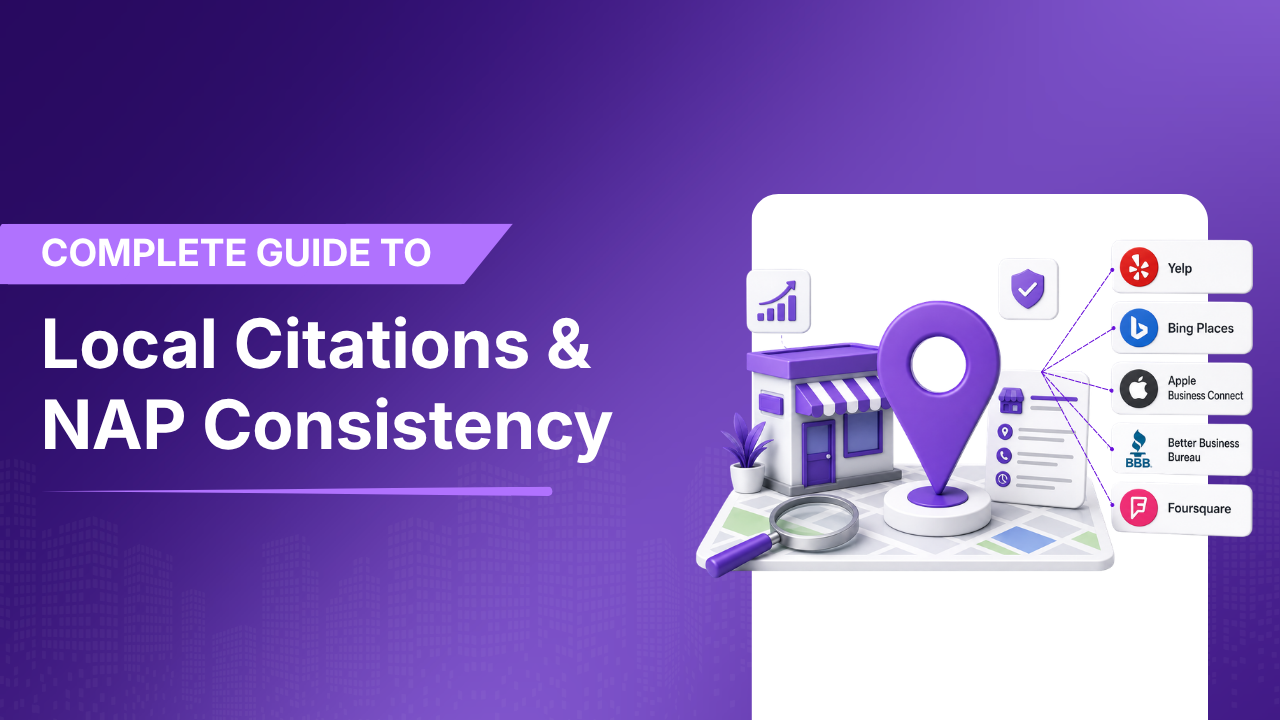
Complete Guide to Local Citations & NAP Consistency
Local citations help businesses build trust and improve their visibility in local search. Consistent business information across directories can strengthen your Google Maps presence and make it easier for customers to find and contact you.
Published on:
Updated on:
Published on:
Last Updated on:
Blog
Summary
Unable to load the audio. Please check the audio file URL.
Local citations are a great way to build trust and improve local visibility and ranking in local search. Correct business information across dictionaries can ultimately strengthen your google map presence, It will be easier for customers to find and contact you too. You need to make sure that the business name, address, or phone number appears differently across websites, directories, social platforms, and other online sources. Google might not be able to understand which information represents your business. This is usually known as NAP consistency, where NAP stands for Name, Address, and Phone number.
What Is a Local Citation?
A local citation is referred to as a mention of your business or another website on the platform. All it contains are business name, address, and phone number, but modern citations. They also include other details such as your website, category, hours, services, photos, and other business information.
Common citations include many things such as business directories, review platforms, industry-specific websites, local organizations, chambers of commerce, professional associations, and community websites. All of them have their own importance. Some of them have a wide audience base, while others are useful because they are closely connected to your industry or geographic area.
Structured Local Citation
A structured citation is a dedicated business listing where your information is organized into specific fields.
ABC Plumbing Services
Austin, TX 78701
Unstructured Local Citation
An unstructured citation is a mention of your business within another piece of content rather than a dedicated business listing.
7 Plumbing Companies Austin Homeowners Can Consider
If you’re dealing with a plumbing emergency in Austin, ABC Plumbing Services is one local company that provides residential plumbing repairs and emergency plumbing services.
Think of citations as references to your business across the web.
The goal isn’t to collect as many listings as possible. Your citation profile should help establish an accurate and consistent identity for the real-world business.
What Does NAP Consistency Actually Mean?
When your business name, address, or phone number are different across different websites, directories, social media, and other online platforms, it can make it difficult for Google to identify and verify your business information. This is known as NAP consistency, which simply means keeping your Name, Address, and Phone number the same everywhere.
ABC Plumbing Services
125 Main Street, Suite 200
Austin, TX 78701
(512) 555-0182
ABC Plumbing
125 Main St.
Austin, TX 78701
(512) 555-0199
ABC Plumbing Services LLC
125 Main Street, Ste 200
Austin, TX 78701
(512) 555-0182
Google can use information from multiple sources, including the business’s website, third-party sources, users, and the business’s own Business Profile. This is why keeping important business information accurate across the web matters.
Not every formatting difference is a citation problem.
The aim is to keep the underlying business information accurate. Don’t waste time treating harmless formatting variations as serious conflicts.
vs. 125 Main St.
vs. Ste 200
vs. 512-555-0182
vs. (512) 555-0199
vs. old address
vs. ABC Plumbing Services LLC
The Most Common Local Citation Mistakes
While creating a citation sounds very simple, a number of mistakes can create bigger problems during a local SEO campaign.
Adding Keywords to the Business Name
Adding a target keyword to your business name can improve your rankings and can also make your listing inaccurate and may violate platform guidelines.
Using an Old Phone Number
Previous phone numbers can remain on directories even after a business has changed its primary contact information.
Creating a New Listing Instead of Fixing an Old One
If an existing listing is incorrect, creating another profile can leave multiple versions of the same business online.
Creating Duplicate Citations
Multiple listings for the same business on one platform can create confusion and make citation management more difficult.
Selecting the Wrong Category
Industry directories often use categories to classify businesses. Choosing an unrelated category can reduce the relevance of the listing.
Submitting to Irrelevant Directories
You don’t need to submit your business to every directory you can find. Prioritize authoritative, local, and industry-relevant sources.
Forgetting Old Business Information
Rebrands, relocations, phone changes, and domain changes can leave outdated business information across the web.
Treating Citation Quantity as the Goal
Hundreds of irrelevant or abandoned listings are not automatically better than a smaller set of accurate and relevant citations.
Should You Add Keywords to Your Business Name?
No you shouldn’t unless the wording is actually part of the business’s real world name.
The target keyword has been inserted into the business name even though it is not part of the actual business identity.
Use the business name that accurately represents the real-world business.
But What If My Google Business Profile Contains a Keyword?
This is exactly the part where many business owners and inexperienced SEO providers become confused.
First determine what the business’s actual real-world name is. If the actual business is ABC Roofing, that is generally the name you should use when creating or correcting citations—not the keyword-expanded version.
What About the Website?
Your website can target keywords without changing the actual name of your business.
What Name Should You Actually Use in Your Citations?
Creating Duplicate Citations Instead of Fixing Existing Listings
Another popular citation mistake is creating a new business listing when an incorrect or outdated listing already exists. For example it is possible that a business may find an old directory profile with a previous phone number and therefore decide to create a new listing with the current information. This sometimes leaves both profiles representing the same business.
If you decide to create a new citation search the platform using your business name, phone number, address, and website. If an existing listing represents the same business, determine whether it can be claimed, edited, updated, merged, or reported according to that platform’s policies. A local citation audit can help identify existing listings before creating a new one.
125 Main Street
Austin, TX 78701
450 Congress Avenue
Austin, TX 78701
Don’t immediately create another listing. First investigate whether the existing listing can be updated to reflect the current business information.
Check these 5 identifiers first
Search the platform using more than just the business name. An older listing may use a little bit different information and may not appear in your first search.
Found an Existing Listing? Here’s What to Do
Use this flow till you decide whether a new citation is necessary or not.
Follow the platform’s process for claiming, merging, suppressing, or reporting duplicate listings where applicable.
Create a new citation using your established, accurate business information.
The main objective is to maintain an accurate representation of your business wherever a citation already exists. Fix an existing listing when necessary, resolve genuine duplicates according to the platform’s process, and create a new citation only when required.
Selecting the Wrong Business Category
Business directories use categories to understand what your company does and which searches your listing may be relevant to. Choosing an inaccurate or overly broad category can make your citation less useful for local search.
For example, a business that primarily provides residential roofing services might select Business Services when a directory offers a more relevant option such as Roofing Contractor. The broader category may technically describe the business, but it doesn’t communicate the company’s primary service as clearly.
Technically describes a business, but provides little information about the company’s actual service.
Clearly communicates the primary service provided by the business.
Different directories use different category systems. You may not find the exact category used on Google Business Profile on Yelp, Bing Places, or an industry-specific directory.
The goal is not identical wording across every platform. Choose the most accurate and relevant category available on that specific directory.
The category doesn’t have to be identical
Different platforms have different ways of organising businesses. What is important is that the selected category correctly represents the business and its major services. This is important when managing local directory listings.
| Platform | Possible Category | Why It Works |
|---|---|---|
| Google Business Profile | Roofing Contractor | Specific category describing the primary service. |
| Yelp | Roofing | The platform may use a different category label. |
| Industry Directory | Roofing Contractor | Industry-specific category with strong relevance. |
| Local Chamber | Construction / Roofing | Uses the categories available within that directory. |
| General Directory | Home Improvement | Acceptable when a more specific roofing category isn’t available. |
Common Category Mistakes
Category selection becomes difficult when businesses choose categories for keyword targeting other than business relevance.
Choosing a Category Only Because It Contains Your Keyword
Don’t just select a category because it contains keywords you want to rank. This category should actually describe what your business is about.
Choosing a Broad Category When a Specific One Exists
If you’re a dentist and a directory offers Dentist, but if you are choosing a broad category such as Health & Medical will provide less specific information.
Selecting Multiple Unrelated Categories
Adding categories that don’t accurately represent your business can create inconsistent information and make the citation less trustworthy.
Keeping an Outdated Category
If your primary service has changed, review important directories and most importantly do not continue to use categories that no longer describe your business.
Is Your Business Category Correct?
Run through these checks before publishing or updating a business citation.
Update the listing using the closest and most specific legitimate category available on that platform. Don’t add keywords to the category or select an unrelated category simply because it has higher search volume.
Choose the most specific, accurate category that the directory actually offers. Your category should describe what your business is, while your services, website content, and other local SEO elements can provide additional context about what you offer.
Using an Old Address
Address changes are one of the most important citation cleanup issues. When a business moves, its new address may be updated on the website and Google Business Profile but the older directories will continue to showcase the previous location.
Dallas, TX
Still appearing on older directoriesDallas, TX
Current website + Google Business ProfileDon’t simply create new listings at the new address. First identify the old citations and update them where possible. Creating another listing can leave multiple representations of the same business on the web.
What Should You Check After a Business Move?
For Google Business Profile purposes, businesses should follow Google’s eligibility and address guidelines. A P.O. box or remote virtual office should not be used as a storefront location simply to create a local presence.
Changing the Address Format Everywhere Just for “Consistency”
NAP consistency does not imply that you need to get obsessed with every punctuation mark or abbreviation. The most important thing is whether the listings show the same underlying business information or not. Local citation audits can help identify meaningful gaps and inconsistencies.
Suite 200
Ste 200
Focus on Real Information Conflicts
125 Main Street
vs.
215 Main Street
Suite 200
vs.
Suite 500
Dallas, TX
vs.
Fort Worth, TX
Prioritize the accuracy of the underlying business information. Formatting differences such as “Street” vs. “St.” are generally less important than an incorrect street number, suite, city, phone number, or address.
Is This an Actual NAP Conflict?
Using Different Business Names Across Platforms
A lot of times businesses use a brand name, DBA name, keyword-rich SEO name, old company name, franchise name or a location- specific name without first thinking which identity should represent the business. Before deciding to start local citation building, establish a proper business identity and use it as the reference point when creating or correcting important listings.
Before starting citation building, establish a canonical business identity and use it as the reference point when creating or correcting important listings.
Use one controlled document when creating or correcting citations. This reduces accidental variations between listings.
Dallas, TX 75201
Which Name Should You Use?
Your master NAP document should act as the source of truth when creating or correcting listings. If the company has genuinely changed its name or undergone a rebrand, update its business information systematically rather than keeping the old and new identities active indefinitely.
What Should Your Local Citation Look Like?
For most businesses, a citation should represent the business naturally and accurately across online sources.
The exact layout may differ between directories, but the underlying business information should remain accurate.
That is not a better citation. It is keyword stuffing.
Which Local Citation Sites Should You Use in the United States?
We don’t have a single “top 100 citation list” that will be equally useful for all the businesses. Your citation strategy needs to combine core platforms, local directories, and industry-specific directories.
Core U.S. Citation Platforms
These are useful starting points for many U.S. businesses.
Bing Places, for example, supports claiming existing listings, adding new businesses, enriching profiles, and verifying business information.
Yelp also provides free business pages and allows businesses to manage their information after claiming their listing.
BBB can be particularly useful for businesses where trust is an important part of the buying decision. BBB allows businesses to submit a free Business Profile, while accreditation is a separate paid program.
Being listed on BBB and being BBB Accredited are not the same thing.Industry-Specific Citation Opportunities
The most useful and important citations aren’t always the general directories. An industry-specific platform can be much more relevant to the business.
Home Services
For plumbers, electricians, HVAC companies, roofers, landscapers, cleaners, remodelers, and similar businesses:
- Angi
- Home-service marketplaces relevant to the specific trade
- Local contractor associations
- Local builders’ associations
- Chamber of Commerce
- City or regional business directories
Legal Services
For attorneys and law firms:
- Avvo
- Justia
- FindLaw
- State Bar directories
- Local Bar Association directories
- County or city legal associations
Healthcare
For doctors, dentists, specialists, and healthcare practices:
- Healthgrades
- Zocdoc
- Relevant medical association directories
- State licensing / board directories
- Local healthcare networks
- Specialty-specific professional directories
Real Estate
For real estate agents and brokerages:
- Realtor.com
- Zillow
- Local REALTOR® associations
- State REALTOR® associations
- Chamber of Commerce
- Local real estate associations
Restaurants & Hospitality
For restaurants, hotels, resorts, and tourism businesses:
- Yelp
- Tripadvisor
- Apple Business Connect
- Bing Places
- Local tourism boards
- Destination marketing organizations
- Chamber of Commerce
- OpenTable, where applicable
A Better Local Citation Strategy: Don’t Chase Quantity
One of the biggest misconceptions in local SEO is that submitting to more directories equals to getting improved google rankings. A stronger approach is to build a relevant and trustworthy local footprint.
That’s an overly simplistic approach.
Core Platforms
Build and maintain the major platforms that apply to almost every business.
Industry-Relevant Platforms
Find directories and platforms specifically related to the business and its services.
Doctor → Healthgrades / Zocdoc
Home services → Angi / Trade associations
Real estate → Realtor.com / REALTOR® associations
Local Sources
Look for organizations that demonstrate a genuine connection to the business’s market.
Supporting Mentions
Build legitimate mentions through relationships and genuine connections within the local ecosystem.
The objective is not to manufacture hundreds of identical directory pages. Focus on accurate, relevant, authoritative, and genuinely connected sources.
NAP Audit: What Should You Check?
Audit the “ NAP issues” first before saying the business has issues. Only the citation won’t be able to decide whether the business information is accurate, current, or trustworthy.
Business Identity
- Is the business name accurate?
- Is it the current brand?
- Is there an old name still appearing online?
- Are keywords being added to the name?
Address
- Is the current address being used?
- Is the suite/unit number correct?
- Are old locations still indexed?
- Are there duplicate locations?
Phone
- Is the primary phone number correct?
- Are old numbers still appearing?
- Are tracking numbers being used incorrectly?
- Are different departments using different numbers?
Website
- Does the citation link to the correct website?
- Does it point to the correct location page for a multi-location business?
- Does the URL still work?
Business Status
- Is the business still operating?
- Has it moved?
- Has it rebranded?
- Has it merged with another company?
- Are duplicate profiles present?
Category
- Does the category accurately represent the business?
- Is the directory using an outdated category?
Hours
- Are the hours current?
- Are holiday hours being handled where the platform supports them?
A smaller set of accurate, relevant, and maintained citations can be more useful than a large collection of outdated, duplicate, or irrelevant listings.
Build a Clear and Trustworthy Business Identity
It is important to understand that a strong local citation strategy does not only mean putting the same keyword-rich business name on 100 websites. The main goal is to create a clear and trustworthy digital presence for the business. The main business information should be correct, major listings should be claimed and maintained, old information should be cleaned up, duplicate profiles should be addressed, and industry- specific directories should be given utmost importance.
Always remember to never change the real business name to forcefully enter a local keyword into citation.
Target “dentist in Chicago” through the appropriate local SEO elements.
Adding keywords to the business name does not make it a better citation.
That distinction helps keep the citation strategy useful for both search engines and real customers.
Audit your local presence and identify citation, NAP, and local SEO issues that may be holding your business back.
How Well Do You Understand Local Citations & NAP?
You’ve made it through the guide. Now test your understanding of local citations, NAP consistency, and citation management with these five questions.
Please answer all five questions before submitting.
Keep learning!
Review the guide and try again.

Recent Blogs
-
Why You’re Losing to Competitors
Every Month Your GBP Sits Outdated, Here’s What You’re Losing…
-
Google Search Console Multimodal Search
Google Search Console’s New Multimodal Search Data: What It Means…