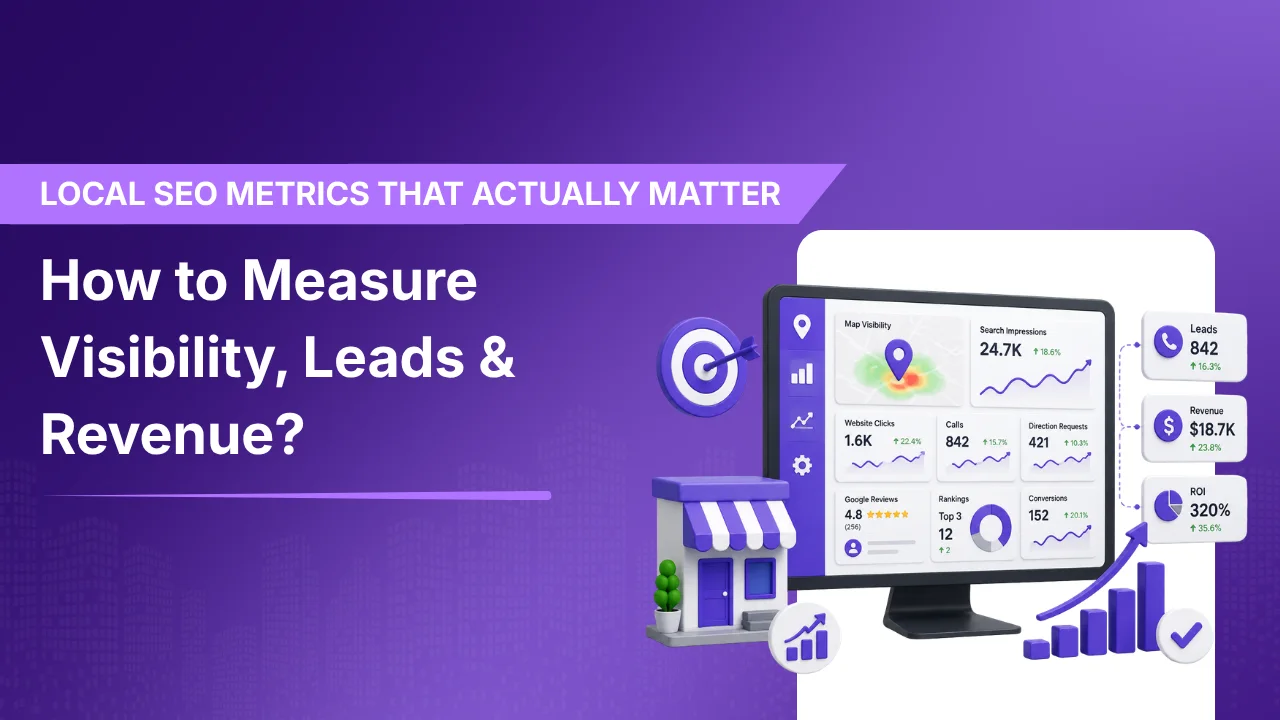
Local SEO Metrics That Actually Matter: How to Measure Visibility Leads & Revenue
Higher rankings are useful. More Google Maps visibility is useful. More website traffic can be useful. But none of these numbers tells the complete story.
Published on:
Updated on:
Published on:
Last Updated on:
Blog
Summary
Unable to load the audio. Please check the audio file URL.
The better question is: Are your local search efforts turning into real customers and revenue?
Local SEO is often known to be a collection of rankings, impressions, clicks and profile views. Those numbers easily show whether your visibility is changing or not, however they won’t tell you if your business is growing or not.
Sometimes due to several keywords, a company might rank higher, but still receive very less enquiries.
That is why the right local SEO metrics should follow the customer’s journey from discovery all the way to conversion.
1. Think of Local SEO as a Funnel
Before deciding which KPI’s you should track, understand what those numbers should show.
A customer searching for local business normally goes through various stages before becoming a permanent customer. Therefore, your measurement should show those stages instead of treating every number as equally valuable.
A metric becomes more valuable as it gets closer to an actual business outcome. Rankings can tell you about visibility. Revenue tells you what that visibility ultimately produced.
2. Measure Visibility for the Searches That Matter
The question of visibility comes when the local customer journey begins. But tracking one keyword in one location gives you only a small part of the picture.
According to Google the local results mainly depend on relevance, distance and prominence. It means the visibility can change based on what the customer is searching and where he is located.
Use Google’s local ranking documentation as the reference point when explaining how local visibility works.
Instead of asking only, “What position are we in?”, check off the searches you’re actually watching right now:
Tap what you already monitor — see how complete your visibility picture really is.
For example, a dental practice might care much more about visibility for “emergency dentist near me” than an informational query such as “what is a dental crown?”
If your business isn’t appearing in the areas where customers search, first review why your business isn’t showing on Google Maps .
3. Separate Profile Visibility From Customer Actions
Google Business Profile Data is important because its job is to provide signals from the platform where many local discovery journeys begin.
Google’s Business Profile Performance documentation covers multiple things of performance information such as searches, views, calls, websites, clicks, direction requests messages and bookings for profiles which are eligible.
The important thing to remember is that visibility and engagement are not the same things.
If only the profile views are increasing while calls, website clicks and other meaningful actions remain low, then just celebrating the increase in visibility factor can hide the conversion problem.
4. Calls Can Reveal Strong Local Intent
For service businesses, a phone call can give more revenue rather than ranking. A person who calls actively may already have a specific problem, question or purchase requirement.
But even calls should not automatically be counted as customers.
Where your systems allow it, check off what you’re currently able to measure:
The closer your checklist gets to “Revenue generated,” the closer SEO gets to the P&L.
If calls are increasing but customers are not, investigate response time, call handling, pricing, availability and the sales process before changing your SEO strategy.
5. Website Clicks Matter Only When You Follow the Journey
Do you know what a website click means from a Business Profile? A website click from a Business Profile means the searcher wants more information. What happens after that click is where the metric becomes commercially useful.
The visitor can read a service page, check pricing, view reviews, click the phone number, submit a contact form, request a quote, or book an appointment . Each one represents a different signal as to how close they are to becoming a customer.
You can use campaign tracking to locate relevant traffic sources. Google’s UTM documentation gives a proper explanation about how UTM parameters can provide campaign information inside Google Analytics.
utm_source=google
utm_medium=organic
utm_campaign=gbp
The goal is not to create complicated tracking for its own sake. The goal is to answer a simple question:
What did the visitor do after local search brought them to the website?
6. Website Conversion Rate Shows Whether Traffic Is Useful
Giving importance to traffic growth is good, but just traffic growth doesn’t guarantee lead growth too. A local business needs to clearly explain the actions that can be considered as conversion. a contact form, a phone click, a quote request, an appointment, a completed booking, a chat enquiry.
For example, if a location page receives 1,000 relevant visitors and produces 50 enquiries, its conversion rate is 5%. Try it with your own numbers below.
Calculate Your Local SEO Conversion Rate
Enter your monthly local-search visitors and conversions to see the conversion rate.
If another page receives the same traffic, but generates suppose 10 enquiries, the SEO traffic is not telling the complete story.
7. Use Search Console to Understand Organic Search Behaviour
The main job of Google Search Console is to add website level search data to your local SEO measurement system. Its performance reporting consists of clicks, impressions, click-through rate and average position, query and page information. Google’s Search Console Performance documentation gives a clear explanation as to how these search performance metrics can be assessed.
| Metric | What It Helps You Understand |
|---|---|
| Impressions | Whether your pages are appearing for more searches. |
| Clicks | Whether searchers are visiting your website. |
| CTR | Whether people choose your result after seeing it. |
| Average Position | How your search visibility is changing over time. |
Never turn average position into your entire SEO report. Search visibility can change across queries, locations and devices, so trends in impressions, clicks and conversions provide important context.
8. Give More Weight to High-Intent Local Searches
Search volume does not equal business value. All you need to do is tap each query type below and watch how the intent and the business value changes automatically.
“how does AC work”
Informational. Useful for early-stage awareness, but rarely leads directly to a booking.
That doesn’t automatically mean informational keywords have no use at all. They can introduce people to a business earlier in the buying journey. But the evaluation shouldn’t be in the same way as transactional searches. Prioritize terms that can combine a relevant service, a meaningful location, a clear commercial need and a realistic path to conversion. These local search metrics can help assess which search terms are important to the business or not.
9. Treat Reviews as Both a Reputation and Performance Signal
Reviews affect how customers assess a business and provide additional information around the customers. According to Google review count and positive reviews can help to improve local prominence. Reputation is part of the broader local search picture.
Instead of monitoring only your average star rating, track:
Review content can also reveal recurring issues with service quality, staff behavior, pricing, waiting times or customer support.
If you’re dealing with reviews that suddenly disappear, see our guide: Google Reviews Disappeared? Here’s How to Find and Recover Them .
10. Direction Requests Are Useful for Physical Locations
Direction requests can be beneficial for businesses that are dependent on physical visits , restaurants, retail stores, clinics, salons, gyms, dealerships and hotels. But don’t consider a direction request as a confirmed store visit. It is a behavioral signal, not a completed transaction.
Where possible, compare direction requests with actual footfall, appointments, bookings or location-level sales.
11. Qualified Leads Matter More Than Lead Volume
A local SEO campaign can generate more enquiries without generating more customers. This happens only when the traffic or enquiries aren’t well aligned with the services, locations or commercial requirements of the business.
Total Leads → Qualified Leads → Customers
Suppose one campaign generates 200 enquiries and 20 customers. Another generates 100 enquiries and 30 customers. The second campaign produced fewer leads but more customers. That is why local SEO lead generation should be evaluated on lead quality, not just lead volume.
12. Move From Leads to Customer Acquisition Cost and Revenue
The moment you connect local search activity with customers, you can begin measuring the economics of the channel.
Customer Acquisition Cost
For example, if a business invests ₹60,000 in local SEO and acquires 30 customers, the simple customer acquisition cost is ₹2,000.
Revenue Per Customer
Customer volume alone doesn’t tell you how valuable those customers are. Forty customers spending ₹10,000 each can produce substantially more revenue than 100 customers spending ₹1,000 each. Where your systems allow it, track new customers from local search, average customer value, revenue attributed to local search, repeat purchases and customer acquisition cost.
Estimate Your Local SEO ROI
Use this simple model to understand the relationship between SEO investment, customers and attributed revenue.
13. Your Local SEO Performance Is Relative
Even while becoming less competitive, a business can still improve its own metrics. Imagine your business gains 20 reviews in a month, sounds good right? But if three nearby competitors gain 60 reviews each, the competitive ground has changed even though your own review count increased.
Competitor analysis contains Google Maps visibility, review volume and growth, average rating, relevant categories, services, local content, website coverage and local citations.
If another business consistently appears ahead of you, read our detailed guide on why competitors rank higher on Google Maps .
You should also make sure your own business information is consistent across relevant directories. Our Local Citations and NAP Consistency guide explains the fundamentals.
14. Build a Local SEO Dashboard Around Business Questions
You don’t need a lot of metrics in every monthly report. A good dashboard can make it easy to understand what has changed and what needs improvement.
| Stage | KPIs | Question |
|---|---|---|
| Visibility | Rankings, impressions, profile views | Are we being found? |
| Engagement | Calls, clicks, directions | Are people interested? |
| Conversion | Leads, bookings, appointments | Are they taking action? |
| Reputation | Reviews, rating, response rate | Are we building trust? |
| Business | Customers, revenue, CAC, ROI | Is local SEO creating value? |
Every metric in the report should help answer a business question or support a decision. If a number doesn’t change what you do next, question whether it belongs in the main dashboard.
15. Use the Numbers to Find the Problem
Reporting becomes important only when the numbers lead to action. Pick the pattern you’re seeing in your own numbers:
16. Connect Google Business Profile Data With Analytics
The more easily your measurement systems can communicate with one another, the easier it becomes to understand what happens after local discovery. Google provides documentation for connecting Business Profile data with Google Analytics , thus bringing Profile interactions and website behavior into a broader framework.
This is important because local discovery becomes more conversational and AI-driven. Searchers can sometimes ask more detailed questions rather than using short, traditional keyword searches. For more context, read our article on how AI is changing local SEO and local search .
The 10 Local SEO Metrics Worth Watching
If you’re building your first local SEO dashboard, check off the ones you already have — and see what’s missing from your setup.
A complete local SEO dashboard, one metric at a time.
As your measurement system matures, add lead-to-customer rate, customer acquisition cost, location-level revenue and competitor comparisons.
The purpose of local SEO measurement isn’t to collect the largest possible number of metrics. It is to understand whether increased visibility is creating meaningful customer actions and business results.
Frequently Asked Questions About Local SEO Metrics
What are the most important local SEO metrics?
The most useful metrics depend on the business, but a strong starting set includes local visibility, Google Business Profile actions, website conversions, qualified leads, reviews, customers and revenue.
Are Google Maps rankings enough to measure local SEO?
No. Rankings show visibility, but they don’t prove that searchers contacted the business or became customers. Rankings should be combined with engagement, conversion and business outcome metrics.
How do I measure local SEO ROI?
Start by connecting local-search activity with customers and attributed revenue. Then compare the revenue generated with the cost of the local SEO investment. Attribution may not be perfect, so clearly distinguish directly tracked and assisted conversions.
What is the difference between local SEO metrics and local SEO KPIs?
A metric is a measurable data point. A KPI is a metric that has been selected because it directly helps evaluate progress toward an important business objective. For example, profile views are a metric, while qualified leads may be a KPI.
Should I focus more on rankings or leads?
Both provide useful information at different stages of the funnel. Rankings help diagnose visibility, while leads and customers help measure commercial impact. A mature local SEO report should connect the two rather than choosing only one.
How often should local SEO performance be reviewed?
Review important trends consistently, but avoid reacting to every short-term fluctuation. Monthly reporting is usually useful for business decisions, while larger trend analysis benefits from comparing multiple periods.
Local SEO Success Is Bigger Than Rankings
Ranking and Visibility are important. Search impressions and Business Profile views still provide valuable information. But those numbers only show the beginning of the customer journey.
When your reporting connects those stages, you can answer much more useful questions: are the right customers finding us, are they engaging with the Business Profile, are they visiting the website, are they becoming qualified leads, are those leads becoming customers, and how much revenue is local search generating?
That’s the difference between reporting SEO activity and measuring SEO performance. The goal isn’t simply to make a ranking report look better. The goal is to make the business perform better.
Your Numbers Tell You What to Fix
A weak metric shouldn’t be shown in your monthly report. Use it to locate the next improvement. Choose the problem that matches your business.
Fix the gap between calls and customers
If your Google Business Profile generates calls, but a lot of them don’t become meaningful conversations, the first step is to recognize what happens when the phone rings.
Turn Local Visibility Into Customer Action
Manage your local presence, monitor customer feedback and turn local search activity into measurable business insights with Revplies.
Explore Revplies
Recent Blogs
-
Why You’re Losing to Competitors
Every Month Your GBP Sits Outdated, Here’s What You’re Losing…
-
Google Search Console Multimodal Search
Google Search Console’s New Multimodal Search Data: What It Means…