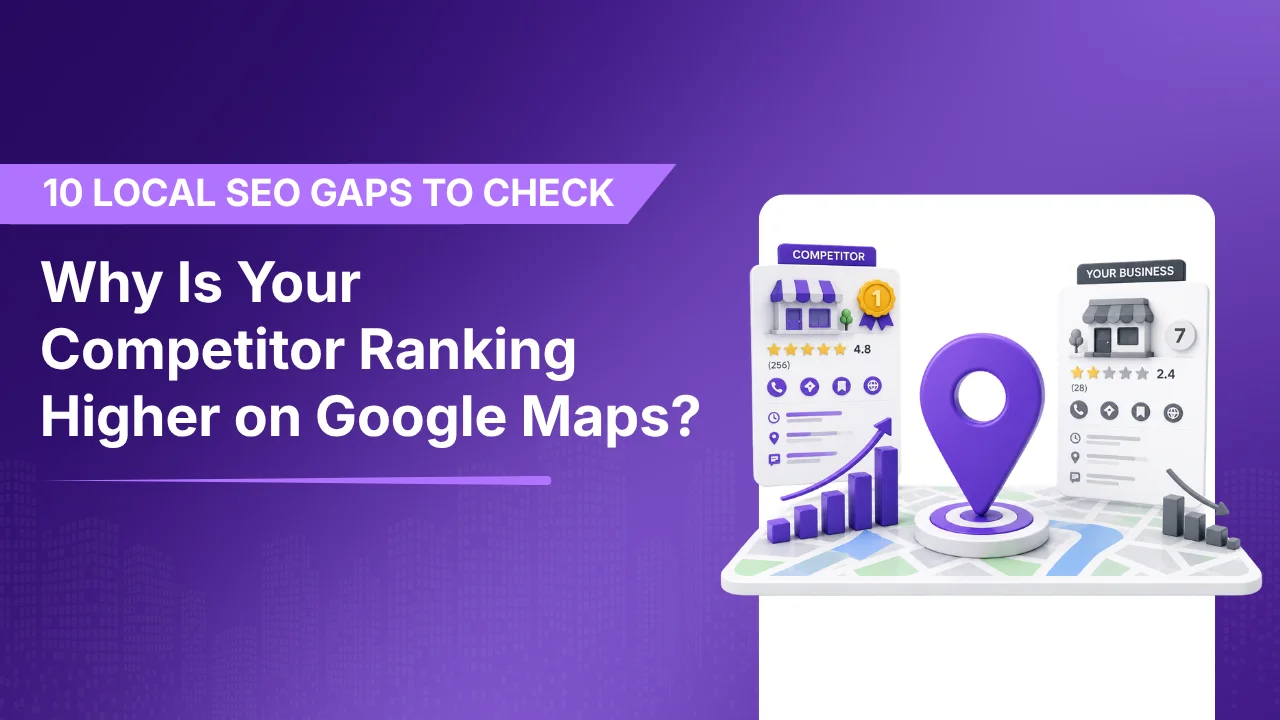
Why Is Your Competitor Ranking Higher on Google Maps? 10 Local SEO Gaps to Check
Your competitor may be ranking higher on Google Maps because of stronger local signals, better reviews, or a more complete online presence. Find the gaps that are holding your business back.
Published on:
Updated on:
Published on:
Last Updated on:
Blog
Summary
Unable to load the audio. Please check the audio file URL.
Your Google Business Profile is complete, your business information is accurate, and you are following local SEO best practices. Yet, when customers search for your services on Google Maps, your competitors appear above you.
So, why is your competitor ranking higher on Google Maps? What are they doing differently?
The answer is not always using some magical SEO trick. Your competitor might be using various things such as local signals, better relevance for the search, stronger website support, or simply be closer to the person searching. So, stop guessing and do a thorough comparison of your business with your competitors that appear above you and identify where your presence is not there.
This guide will help you find those gaps and understand what you can do about them.
1. Your Competitor May Have Stronger Local Signals
Google checks multiple things when deciding whether local businesses are relevant to a search or not. These can include several factors such as:
- How relevant the business is to the search
- The accuracy of its Google Business Profile
- Honest customer reviews
- The business’s popularity and reputation
- Relevant mentions and links across the web
- Website content supporting the business and its services
- The location of the business relative to the searcher
What it means is that just having a well-optimized profile does not guarantee that you will necessarily appear above your competitor only. It can be possible that they generally have a strong overall presence.
The important question is:
Where is your competitor stronger than you?
That is what you need to identify before changing your SEO strategy.
2. Start With the Competitor
Who Is Beating You
Don’t compare yourself with 20 other competitors. Start just with one competitor that appears above you when you search locally. This is where local SEO competitor analysis can help you identify what they are doing differently.
Choose One Competitor
Find a business that consistently appears above you when customers search for your main service.
Compare Local Signals
Look at the profile, reviews, website, citations, mentions, backlinks and other local signals Google can see.
Find the Gaps
Don’t copy the competitor. Identify the areas where your local presence is weaker and prioritize what you can improve.
Your Profile vs. Their Profile
The objective isn’t to replicate everything your competitor does. It’s to understand where your local presence is falling behind.
3. Is Your Primary Category Working for You?
Your primary category helps Google understand what your business mainly does. The right category can improve how well your business matches relevant local searches.
Roofing Contractor
Roofing Contractor
Your primary category may be competitive – but your profile could be missing relevant secondary categories.
This doesn’t imply that you will have to copy your competitor. Review whether additional categories correctly represent the services or business types you actually offer. This is an important part of your Google Business Profile competitor analysis.
Ask yourself these 4 questions
Your primary category needs to show your primary business offering.
Check whether additional categories accurately showcase your business or not.
Every selected category should genuinely describe what your business provides.
Check whether an accurate category exists for an important part of your business.
Only select categories that accurately describe your actual business and the services you provide.
4. Is Your Profile Showing Everything You Offer?
Your Google Business Profile should show the services your business actually provides. A competitor listing more services does not automatically mean they will rank higher, but it can definitely show that your profile isn’t properly conveying your offerings. This is one of the Google Maps ranking factors.
Service Coverage
Service Coverage
Your competitor has broader service coverage.
This doesn’t mean that their profile ranks higher because they have more services. All you need to do is check whether your profile is missing services that you genuinely provide Are important services missing?
Are important services missing?
Review your actual service offering and add relevant services No, my services are complete.
Move to the next local signal and look for another competitive gap with accurate descriptions.
Review your Google Business Profile services and make sure every important service you actually provide is accurately represented.
5. Your Reviews Tell a Competitive Story
Reviews make visible differences between competing local businesses. So, don’t just look at the number of reviews but instead the quality, rating, recency and consistency of customer feedback. These differences can reveal local SEO gaps that may be affecting your visibility.
Your Local Profile
Competitor Profile
350 reviews don’t automatically beat 120 reviews.
Look at the bigger picture. A business with hundreds of old reviews may have a different competitive position from one that consistently receives genuine new reviews.
Compare these 7 signals
Build a sustainable review process.
Ask genuine customers for feedback after a completed service or positive customer interaction. Make review collection a consistent part of your customer experience instead of a one-time campaign.
Do not buy reviews, create fake reviews, incentivize misleading feedback, or manipulate review content. Focus on earning authentic customer feedback.
6. It’s Not Just About Reviews. It’s About Consistency.
A business receiving genuine customer feedback consistently may have a stronger review activity pattern than a business that receives reviews only occasionally.
Last 6 Months
Your competitor’s review activity is more consistent.
Higher review frequency isn’t the only reason for competitors to rank higher. It tells you that their customer feedback activity is regular and stronger.
Look at the last 3–6 months.
One unusually active week doesn’t tell you much. Try to track a regular pattern: does your business regularly receive genuine reviews, or are there long periods where your profile receives little or no feedback?
Is my review acquisition consistent?
Build review collection into your customer journey.
Don’t just ask for reviews only when you remember, create a proper process for requesting genuine feedback after completed services or positive customer interactions.
7. Don’t Just Collect Reviews. Respond to Them.
Review responses are often overlooked. A consistent, professional response strategy helps show customers that your business is active, attentive and willing to engage with feedback.
How engaged are you?
Don’t respond just to manipulate rankings.
The main aim is customer communication. Professional responses show that your business is paying attention and gives importance to customer feedback.
How strong are your responses?
Do your responses acknowledge customers who took the time to leave feedback?
Do you handle negative or critical feedback with a calm mind and in a professional way?
Are responses part of your regular reputation management process?
Do your replies feel natural instead of using the same repetitive template every time?
Give proper responses, make it clear that customer feedback matters to you?
Make every response feel like a conversation – not a ranking tactic.
Use review responses as part of your overall reputation management process. Be helpful, specific, professional and genuine.
Review your recent Google reviews and check whether your responses are timely, professional, relevant and consistent.
8. Your Google Profile Should Look Active.
Open your profile and your competitor’s profile side by side and then check thoroughly. The aim should not be to have the most photos, it is to ensure customers can clearly see your business, services, work and customer experience.
What does your profile actually show?
When was the last time you added a useful photo?
A profile with plenty of old images may tell a different story from one that is regularly updated with authentic business activity.
Don’t upload photos just to increase the number.
Every image should have a reason to exist.
If a new customer opened your profile today, would your photos help them choose you?
If the answer is no, your opportunity isn’t simply to add more images. It’s to improve the quality, variety and relevance of the visual content on your profile.
9. Is Your Website Supporting Your Google Profile?
Your Google Business Profile and Website should be the same. It shouldn’t tell a different story. If your profile clearly showcases your locations and businesses but your website doesn’t provide any supporting information regarding the same, you may be creating local SEO gaps that can affect your visibility.
What do you offer?
- Business category
- Services
- Location
- Reviews
Can you prove it?
- Service pages
- Location pages
- Detailed information
- Projects & case studies
Can they trust you?
- Understands your service
- Finds their location
- Sees your expertise
- Knows what to expect
What does your website actually cover?
Can your website answer these five questions?
If a customer lands on your website after finding you on Google Maps, they should immediately understand what you do and why you’re relevant to them.
Is your main service clearly explained?
Are the locations you genuinely serve clear?
Is your ideal customer or audience obvious?
Are important services supported by useful pages?
Do you demonstrate expertise, experience or trust?
Your website shouldn’t just exist. It should support your local presence.
Build useful service, location and supporting content where it genuinely helps customers understand your business. Don’t create pages simply to increase the page count.
Google Profile + Website = One consistent business story.
Your Google Business Profile tells people you exist. Your website should give them the depth, information and confidence to understand your business.
10. How Strong Is Your Presence Beyond Google?
Your competitor may appear across various directories, local organizations and industry websites while your business has very few mentions. You can also compare where both businesses are being discovered outside google.
Where can customers find your business?
31 citations aren’t automatically better than 12.
The value of a citation depends on its accuracy, relevance and trustworthiness-not simply the number of websites mentioning your business.
Check these seven source types
One wrong business detail can create an unnecessary problem.
When reviewing citations, check your business name, address, phone number and other important details for consistency. Fix inaccurate listings before focusing on creating more.
Build fewer, better local signals.
Focus on accurate, relevant and trustworthy citations and mentions. Don’t submit your business to hundreds of low-quality directories just to increase a number.
11. Who Is Talking About Your Business?
Citations inform google where your business is listed. Local lists and mentions talk about a broader story, its relationship, expertise and presence within the community.
Your business doesn’t exist in isolation.
A website links to your business.
For example, a local association lists your company as a member and links to your website.
Your business is genuinely referenced.
For example, a local publication discusses your project or community involvement, even when there isn’t a direct website link.
Where could your business genuinely belong?
Your competitor may have stronger local relationships.
Ask these three questions.
Does the website, organization or audience have a genuine connection to your business?
Is this a real organization, publication, business or community resource?
Is there a genuine reason your business should be featured or referenced?
Don’t chase links. Build reasons to be mentioned.
Look for legitimate opportunities where your business can contribute something useful to a local community, industry or audience. The goal is meaningful visibility-not a bigger backlink count.
12. Sometimes the Problem Is Where You Search.
Proximity, one of the most important local ranking factors, is something you cannot control. Google Maps Results can vary depending on where your searcher is located, even when the same businesses are being searched.
Same search. Different location. Different visibility.
Your Maps position can change based on several variables.
Test visibility from multiple areas.
Don’t spend your SEO effort fighting what you cannot change.
- Where the searcher is located
- Where competitors are physically located
- Distance between businesses and searchers
- Google Business Profile completeness
- Relevant reviews and reputation
- Website and local content
- Relevant local mentions and links
- Overall local presence
“Why am I not number one?”
“Where am I losing visibility, and what can I realistically improve?”
Local search is influenced by the searcher’s location and the competitive landscape around them. Measure your visibility across multiple locations and focus your effort on the signals you can actually improve.
13. Turn Your Competitor Research Into a Gap Score.
You have compared the important local signals. Now all you need to do is turn those observations into a simple score especially at places where competition is high and local SEO gaps are significant.
Rate each signal from 0 to 3.
Score your local presence
Compare your business with the competitor you selected and give each local signal a score from 0 to 3.
Your score will help you identify the areas where your local presence may need the most attention.
What should you do with your score?
The signal is significantly behind your competitor. You need to look for realistic improvements before moving to lower-priority areas.
Your position is reasonably comparable. Continue maintaining the signal while looking for bigger opportunities elsewhere.
You’re stronger than any competitor in your area. Maintain the advantage while investigating weaker signals.
This is not Google’s ranking formula.
Google does not publish a 45-point local ranking score. This framework is simply a practical way to organize your competitor research and identify where your local presence needs attention.
Don’t try to fix everything at once.
Start with the signals where you scored 0 or 1. These are the areas where your competitor has the clearest advantage and where improvement may have the greatest practical value.
Find Your Biggest Three Gaps
You don't have to fix everything at once. Focus on the three areas where your competitor has the clearest advantage and turn your audit into an actionable plan into an actionable plan to improve Google Maps ranking.
Reviews
Your competitor has a substantially larger body of customer feedback. Review growth and reputation may be an important area to investigate.
Local Mentions
Your competitor appears across more relevant local sources, giving them a broader presence beyond their own website and Google profile.
Website Support
Your competitor provides more location and service information that supports their local search presence.
Stop saying "I need better local SEO."
Now you know exactly where the gaps are. Start with your biggest three, prioritize the areas you can realistically improve, and measure your progress over time.
Your goal isn't to copy your competitor. It's to understand where their local presence is stronger and build a better, more complete presence of your own.
Find Your Local SEO Gaps
You have compared your business with a competitor. Now turn what you discovered into a simple improvement plan.

Recent Blogs
-
Why You’re Losing to Competitors
Every Month Your GBP Sits Outdated, Here’s What You’re Losing…
-
Google Search Console Multimodal Search
Google Search Console’s New Multimodal Search Data: What It Means…
-
Your Google Ranking Went Up
Your Google Ranking Went Up. Here’s What That Actually Means…
-
Google Business Profile Collected Info
Google Business Profile “Collected Info”: What It Is, How It…
-
How to List Your Business on Google Maps
How to List Your Business on Google Maps: A Complete…
-
How to Add Products & Services to Your GBP
How to Add Products & Services to Your Google Business…