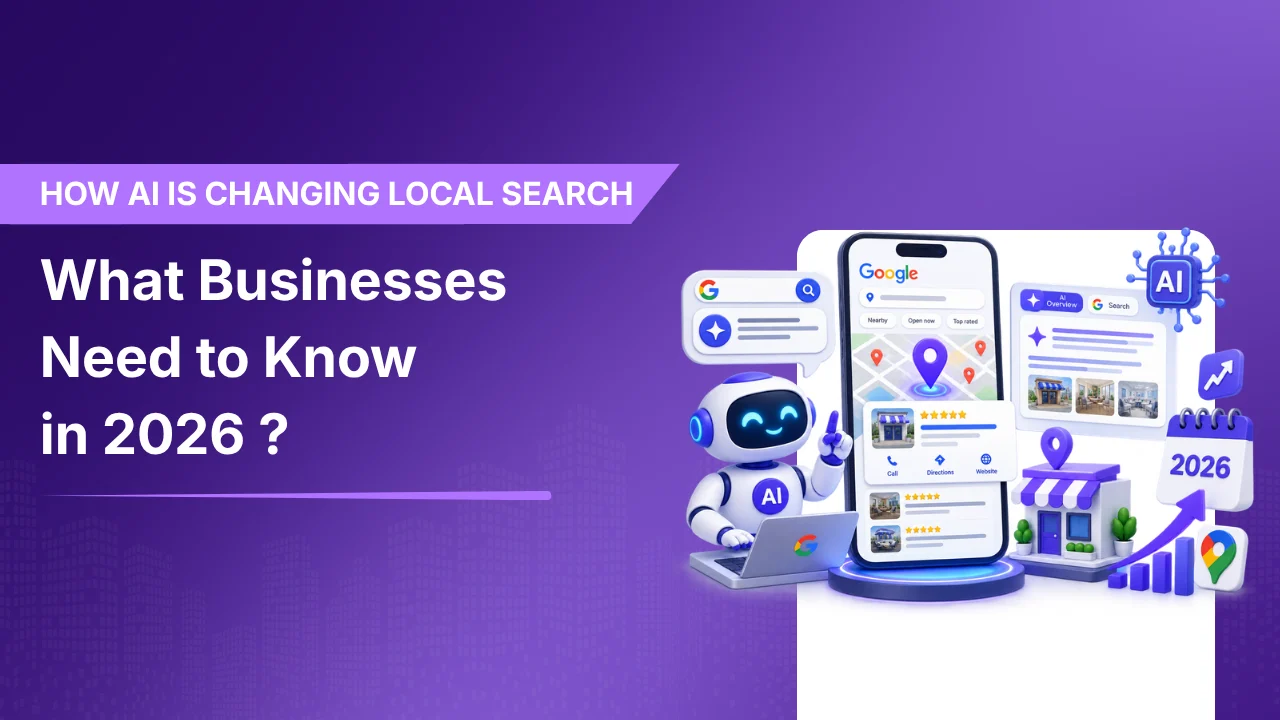
How AI Is Changing Local Search: What Businesses Need to Know in 2026
If you want to understand how AI is changing local search, this guide explains what businesses need to know in 2026. Learn how AI-powered search and complete business information can affect your visibility and help you attract more customers.
Published on:
Updated on:
Published on:
Last Updated on:
Blog
Summary
Unable to load the audio. Please check the audio file URL.
AI is changing how customers discover, evaluate, and choose local businesses. Here’s what that means for your Google Business Profile, Google Maps visibility, reviews, website, and local SEO strategy.
For years, local SEO was largely about one goal: get your business to appear when customers search for what you offer nearby.
Businesses optimized their Google Business Profile, selected relevant categories, built local citations, collected Google reviews, created location pages, and worked to improve their Google Maps visibility.
But AI and local SEO are changing how people discover and evaluate local businesses.
A customer doesn’t always search with a short keyword anymore.
From keywords to context
These searches require more than matching a keyword to a business.
The search system needs to understand the business, its services, location, reputation, and relevance to the customer’s situation.
Read Google’s documentation →
At the same time, Google is adding more conversational capabilities to Maps. In March 2026, Google introduced Ask Maps, allowing people to ask complex, real-world questions about places using Gemini.
So the question for businesses is no longer simply:
It is becoming:
What AI Needs to Understand About Your Business
A strong local SEO strategy should make the important information about your business clear and consistent.
1. AI Is Changing How Local Search Works
A traditional local search starts with a specific query.
It is the job of Google to decide which businesses are relevant to that query and where they are located.
Relevance, distance, and prominence are the main factors local results are based on. Google also says providing complete and accurate information can help Google to properly understand a business and match it with correct searches. This is why AI in local SEO doesn’t only mean replacing the fundamentals. It is about making those fundamentals easier for search systems to understand and use.
But AI-powered local search can introduce more context.
Service
What does the business actually provide?
Location
Does the business serve the customer’s location?
Relevance
Does the business match the customer’s specific need?
This is why AI in local SEO isn’t about replacing the fundamentals.
It is about making those fundamentals easier for search systems to understand and use.
2. Your Google Business Profile Is Still the Foundation
AGoogle doesn’t make your Google Business Profile completely irrelevant. On the other hand, accurate business profile information becomes even more important.
For effective Google Business Profile optimization, start with the basics.
Google explains that complete and accurate business information can help a business appear in relevant local searches.
3. AI Needs Context, Not Just Keywords
The biggest change brought by A.I. Powered Search is its capability to understand context.
“Professional digital marketing company providing quality services.”
“Performance marketing agency helping B2B companies generate qualified leads through Google Ads, Meta Ads, landing pages, and conversion-focused campaigns.”
The second description provides substantially more information.
It explains what the business does, who it serves, which services it provides, and how those services are delivered.
This doesn’t mean you should stuff every possible keyword into your content.
It means your local business information should be clear, specific, and useful.
4. Your Website Is an Important Source of Local Business Information
Your Google Business Profile does provide important information about your business but your website can provide a lot more information.
This is where your local business SEO strategy should establish a connection with your website content.
Services
Clearly explain what you provide and the problems you solve.
Locations
Clearly identify the locations you genuinely serve.
Questions
Answer the questions customers ask before choosing you.
The objective isn’t to write content specifically for an AI system.
You’re trying to make the business easier to understand.
5. Google Reviews Are Becoming a Source of Business Context
Google Reviews play an important role in local search. But there is a difference between having reviews and having useful customer feedback.
“Great company!”
“They repaired our AC the same day and explained why the unit wasn’t cooling properly.”
Google says customer reviews can have their contributions in Place Topics and review snippets and also highlights common themes and information found in reviews.
The solution isn’t to tell customers what keywords to use in their reviews.
Instead, what you can do is to create good customer experiences and ask reliable customers to leave honest reviews.
If you are facing the problem of deleted reviews, read our guide on how to see deleted Google reviews .
6. Local Citations Still Matter – But Quality Matters More Than Quantity
Local Citations is another part of Local SEO.
But local SEO shouldn’t become:
Instead, ask:
Relevant sources might include:
The main aim is to gain accuracy and relevance.
That’s why NAP consistency remains an important consideration in local SEO.
Read our complete guide to local citations and NAP consistency for a deeper explanation.
7. Google Maps SEO Is Becoming More Conversational
Google Maps has been an important part of local search. Businesses therefore invest a lot in Google Maps SEO and improve their Google Maps Visibility.
But the map is slowly evolving.
In March 2026, Google launched Ask Maps, which uses Gemini to answer complex questions about real-world places.
Ask Maps and Gemini →
In August 2026, Google announced additional Ask Maps improvements in India, including Hindi-language support, real-time transit information, and Personal Intelligence.
8. AI Visibility Is Not the Same as a New Ranking Factor
This is where businesses need to be cautious.
You may see claims such as:
Those claims should be treated cautiously.
Google says the primary factors for local ranking are relevance, distance, and prominence.
Google also says it gathers local business information from multiple sources.
But that doesn’t mean Google has published a checklist saying:
It hasn’t.
Therefore, AI search optimization should not become another collection of unsupported SEO myths.
What We Actually Know About AI & Local Search
9. What Should Businesses Optimize for AI-Powered Local Search?
If there isn’t a magic AI ranking factor, what should you actually do?
Be Clear
Clearly explain what your business does.
Be Complete
Don’t leave important business information unnecessarily incomplete.
Be Consistent
Keep important information aligned across your digital presence.
Be Specific
Describe actual services, locations, customers, and expertise.
Be Verifiable
Support your business information with genuine evidence.
Stay Current
Keep hours, services, contact details, and other information updated.
10. What If Your Business Isn’t Showing on Google Maps?
Before worrying about AI visibility, make sure your business can actually be found through traditional local search.
If your business isn’t showing on Google Maps, check:
Read our detailed guide on why your business isn’t showing on Google Maps .
11. Why Google Maps Rankings Still Matter
AI doesn’t make traditional Google Maps ranking useless.
According to Google local results are mainly based on relevance, distance, and prominence.
If a competitor is consistently appearing above your business, don’t immediately assume they are simply doing “AI SEO” better.
Compare:
Read our guide on why competitors rank higher on Google Maps to work through that comparison.
12. Local Search Visibility Is Only Valuable If It Creates Customers
Ranking is not the main goal.
It can be possible that a business has strong Google Maps visibility but still receives very few calls, appointment requests, website visits, quote requests, or bookings.
This is the reason a good local visibility is needed to connect visibility with conversion.
Once someone discovers your business, make the next step obvious.
Call
Make contacting the business simple.
Book
Give customers a clear appointment path.
Convert
Turn local discovery into a real customer action.
Read our guide on how to turn Google Maps visibility into more appointments .
The Future of Local SEO Isn’t About Optimizing for One AI
It is sometimes very strange to think that businesses now need a completely separate and new strategy called “AI SEO”.
That’s not quite right.
The fundamentals of local business SEO still matter.
However one thing which is changing is how customers can ask for information and how search systems are able to interpret that information available regarding your business.
So the future isn’t simply about being visible.
It’s about being understood properly and to be considered and chosen.
Is Your Business Ready for AI-Powered Local Search?
Your Google Business Profile, website, reviews, citations, and Google Maps presence all contribute to how your business is understood online.
Explore Revplies →
Recent Blogs
-
Why You’re Losing to Competitors
Every Month Your GBP Sits Outdated, Here’s What You’re Losing…
-
Google Search Console Multimodal Search
Google Search Console’s New Multimodal Search Data: What It Means…