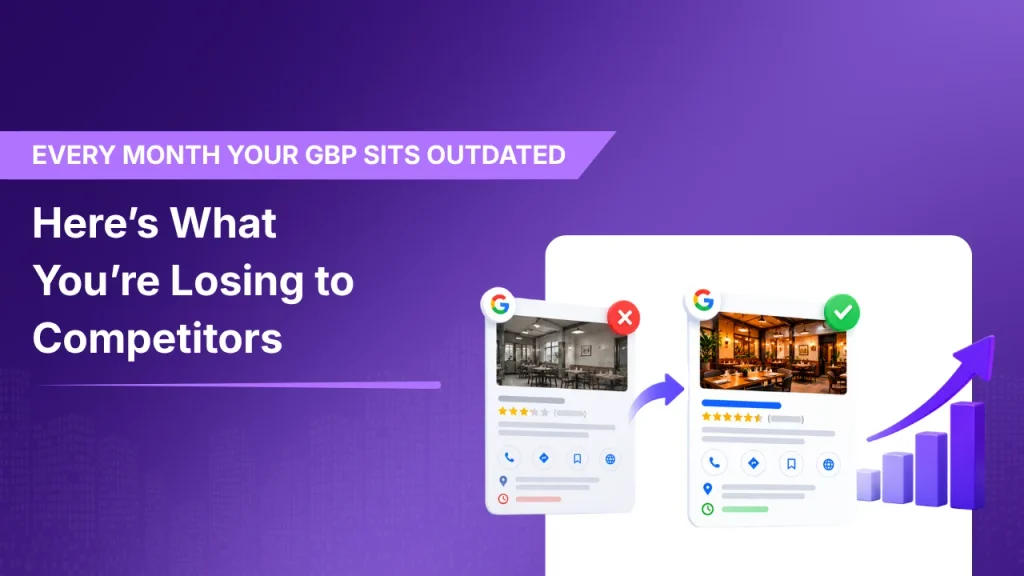
Local SEO vs Traditional SEO: Key Differences Every Business Owner Should Know
If you want to understand local SEO vs traditional SEO, the key is knowing how each approach helps your business reach the right customers. Local SEO focuses on nearby customers, while traditional SEO helps build broader online visibility. This guide explains the key differences and how to choose the right SEO.
Published on:
Updated on:
Published on:
Last Updated on:
Blog
Summary
Unable to load the audio. Please check the audio file URL.
Local SEO vs Traditional SEO: Key Differences Every Business Owner Should Know
Are you a local business owner, or do you want to reach customers across the country and around the world? In both cases, SEO can help your business succeed. But local SEO vs traditional SEO is not simply about using different keywords. The right strategy depends on who your customers are, what they are searching for, and where they need your business.
A lot of people think SEO is just SEO, and that you can apply a random strategy and carry on with the process. But when a customer searches Google for a business, the results they see do not depend only on the words they type.
Someone searching for “best project management software” may be comparing companies from across the India or even around the world. Someone searching for “best dentist near me” is looking for a business that can serve them locally.
This difference is what makes local SEO different from traditional SEO. There is always a proper strategy behind SEO. In the case of local SEO, the strategy is targeted at a specific area. The elements of traditional SEO and local SEO are different, so let’s look at the key differences between them.
What Is Traditional SEO?
The main goal of traditional SEO is to improve a website so that it appears in Google’s organic search results. These are the blue links that most people automatically think of when they hear the word “Google results.”
The main attention is on the website. Businesses research keywords, create useful content, improve technical elements, build relevant backlinks, optimize pages, and make sure their websites provide a good experience for visitors.
For example, a software company might want to rank for searches such as:
- project management software
- CRM software
- email marketing software
- accounting software
- customer service software
A person searching for these terms could be living anywhere in the India or in the world. The search is generally focused on finding information, comparing products, or evaluating a solution rather than finding a nearby business.
What Is Local SEO?
If a business wants to become more visible to people searching for products or services in a specific area, then it needs to take help from local SEO. This means understanding the buyer’s psychology and what they think when they search for a business nearby.
They might search for:
- dentist near me
- plumber near me
- HVAC company in Bangalore
- best restaurant in Mangalore
- auto repair shop near me
- real estate agent in Mysore
This is the reason local search engine optimization is important for businesses that serve customers within a city, neighborhood, region, or defined service area.
Local SEO also includes areas that are not the main focus of traditional SEO, such as Google Maps, Google Business Profiles, local reviews, and local citations.
Local SEO vs Traditional SEO: What’s the Difference?
The location and search intent are mainly different in traditional and local SEO. The main goal of traditional SEO is to make a website visible to a wider audience. A company may be thinking of reaching customers throughout the India or internationally.
Local SEO, on the other hand, focuses on being visible to customers in the places where a business actually operates.
Let’s take a dental clinic in Bangalore as an example. It could publish an article targeting:
“How often should you visit the dentist?”
That article could attract readers from anywhere. But the same practice may also want to appear for searches such as:
- dentist in Bangalore
- emergency dentist near me
This is why local SEO for small businesses can be beneficial. It helps businesses reach people who are searching for services in the areas they actually serve.
Where Do Local SEO and Traditional SEO Results Appear?
Google search results make it easier to understand the differences. Traditional SEO mainly focuses on organic results and the blue links. Suppose someone is searching for “best accounting software.” They may see websites from companies competing for customers throughout the India or internationally.
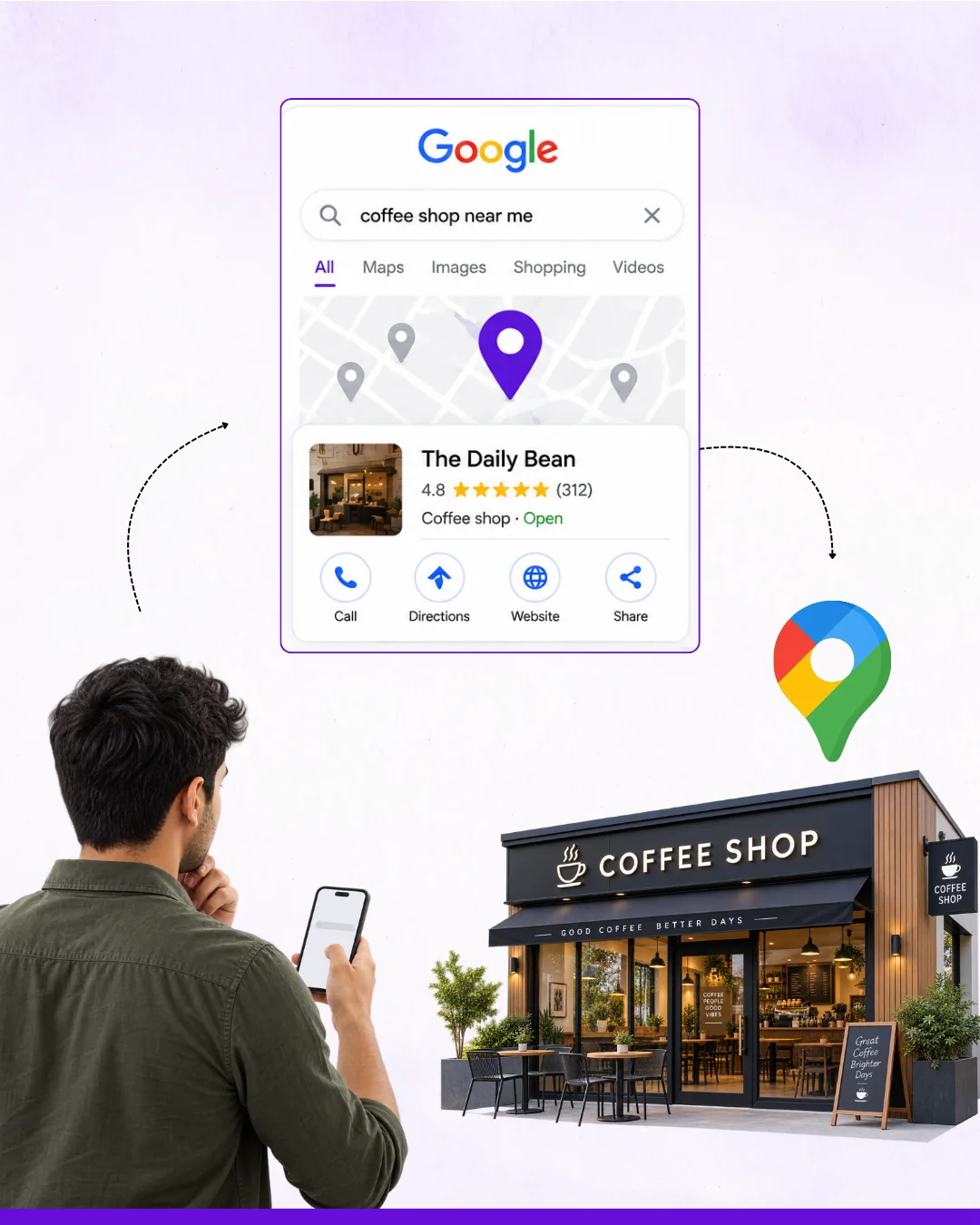
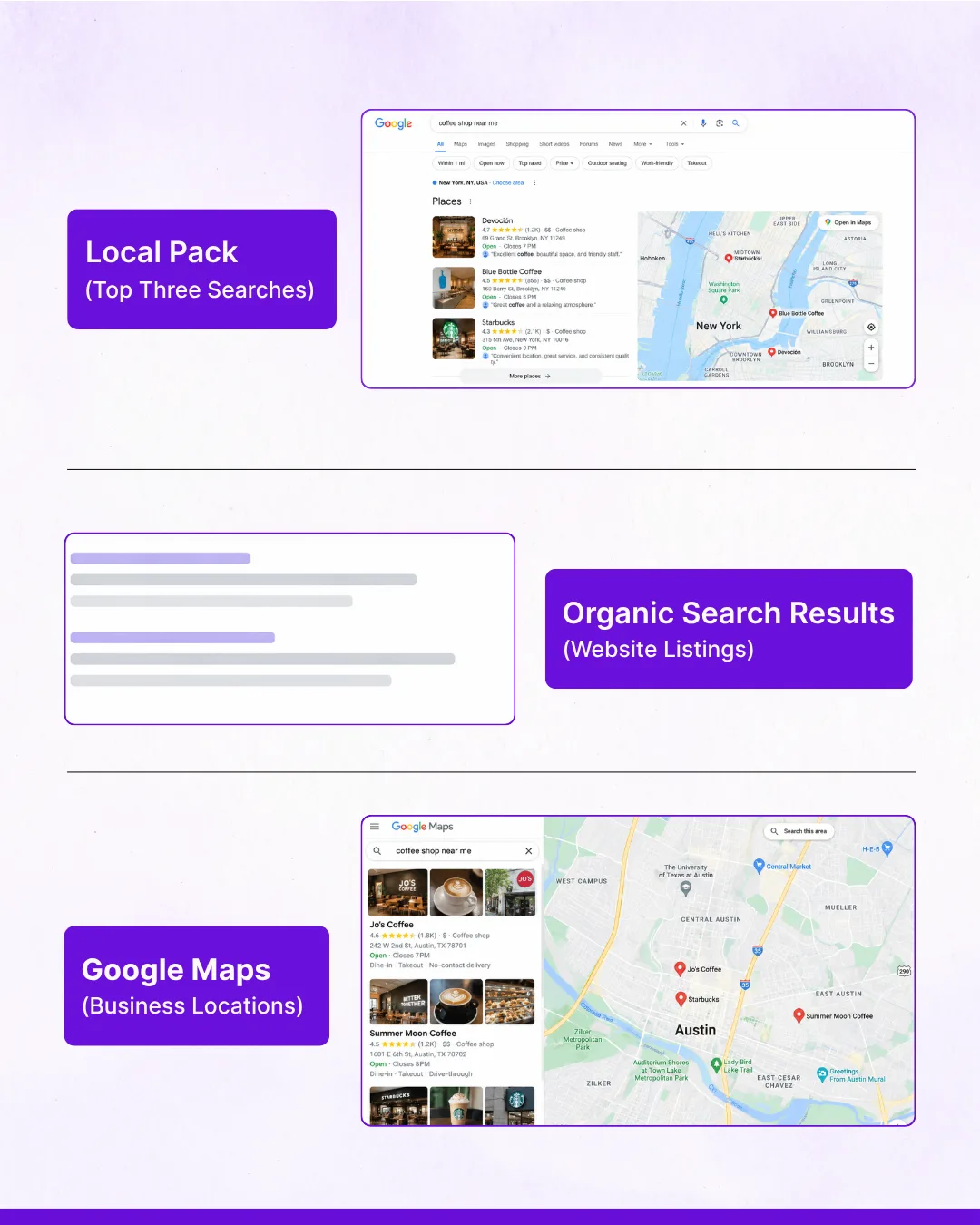
Local searches can also produce local packs, commonly known as the Google Map Pack. If you search for “dentists near me,” Google may show local businesses along with information such as:
- Business name
- Star rating
- Google reviews
- Address
- Phone number
- Business hours
- Website
- Directions
This is where Google Maps SEO and Google Business Profile optimization become crucial.
A local business can appear in the Local Pack and also rank in the organic blue-link results through its website.
Local SEO does not replace traditional SEO. Instead, it gives a business another opportunity to be found by customers who are searching locally.
Local SEO vs. Traditional SEO: Side-by-Side Analysis
Both traditional and local SEO improve rankings in search results to help more people find, contact, and buy from a business. Here’s the difference.
Win nearby customers
Focuses on visibility in the areas where a business operates and helps customers find, contact, or visit a nearby provider.
- Location-based search intent
- Google Maps and Local Pack
- Google Business Profile
- Local reviews and reputation
Build broader visibility
Focuses on improving a website’s organic search visibility for broader topics, products, services, and information.
- Broader search intent
- Organic website results
- Content and technical SEO
- Backlinks and website authority
Which SEO approach fits your business?
Select the statements that describe your business. Your results will update automatically.
Your result Select a few statements to see which approach may be the best fit.
1. Target Audience
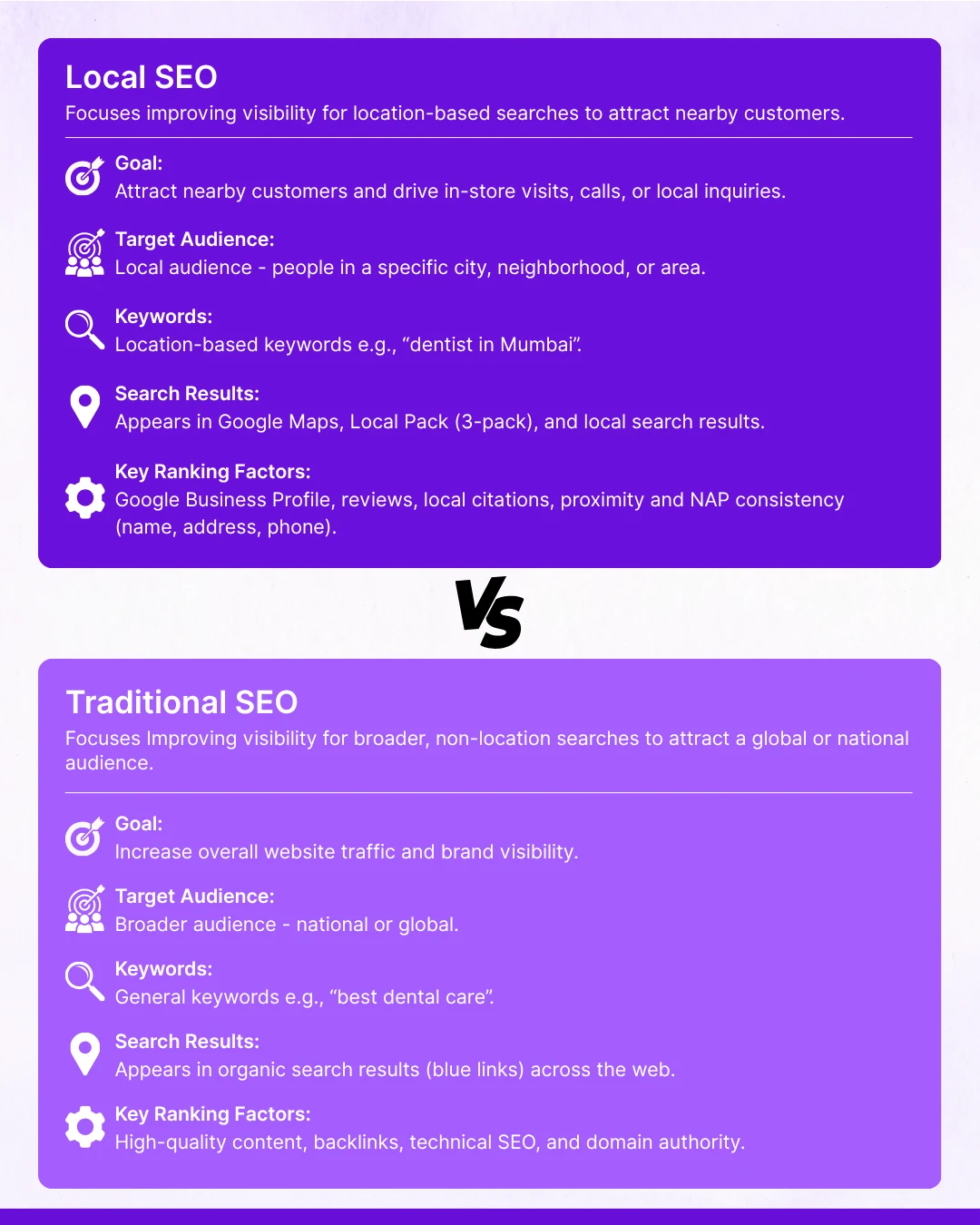
Local SEO targets users who want nearby solutions. These individuals are often looking for businesses they can visit, contact, or hire quickly. Location plays an important role in their decision-making, and search relevance depends partly on how close the business is to the user.
Traditional SEO generally targets users researching products, services, or information without a strong focus on physical location. These users may evaluate businesses based on quality, expertise, product specifications, or other factors rather than distance.
2. Content Strategy
Local SEO’s content strategy uses location-specific keywords and user intent. Businesses may include neighborhood references, city names, and geographic terms within relevant headings and body text.
For example, a plumber might create a service page targeting “emergency plumber in Bangalore” rather than only “emergency plumbing services.” These are also known as local SEO keywords.
Traditional SEO focuses more on broader topics, keywords, and search intent. A software company might publish a guide about project management features, comparisons, or best practices without targeting a particular city.
The key difference is not simply adding a location to every keyword. Local content should be useful to the people and places the business actually serves.
3. Google Business Profile and Google Maps
Google Business Profile optimization is an important part of local SEO. Businesses can use their profile to provide important information about their services, location, hours, and other details that help customers decide whether to contact them.
Traditional SEO primarily focuses on improving a website’s organic search visibility. It does not usually require a business to manage a local business profile or compete for a place in the Google Map Pack.
However, this does not mean a website alone is sufficient for a local business. A strong local SEO strategy should consider both Google Maps ranking and organic website visibility.
4. Ranking Factors
Both approaches require relevant content, a useful website, and other SEO fundamentals. However, local SEO ranking factors also include signals connected to the business’s location and local relevance.
These may include:
- Relevance to the search query
- Business information and category
- Location and proximity
- Local reputation and reviews
- Website quality and relevance
- Local citations and business information consistency
Traditional SEO focuses more on broader website-related factors, such as content quality, technical SEO, backlinks, and the website’s ability to satisfy search intent.
The exact importance of individual factors can vary by search and business type, so businesses should avoid treating any single factor as a guaranteed ranking shortcut.
5. Google Reviews and Online Reputation
Online reputation management is especially important for businesses that depend on local customers. People often check reviews before deciding whether to visit, call, or hire a business.
Google reviews can help potential customers understand what to expect from a business. They also contribute to the overall local search experience and can influence how people evaluate competing businesses.
Traditional SEO may benefit from a business’s reputation and brand presence, but it generally does not place the same emphasis on local review management as local SEO does.
6. Search Results and Visibility
Traditional SEO mainly aims to improve a website’s visibility in organic search results.
Local SEO can help a business appear in several places, including:
- The Google Map Pack
- Google Maps
- Local organic search results
- Google Business Profile information
- Other relevant local search features
For example, a restaurant may want to rank for “best Indian restaurant” through traditional SEO while also appearing for “Indian restaurant near me” through local search optimization.
This is why local SEO vs SEO is not always an either-or decision. Many businesses benefit from using both approaches together.
7. Link Building and Local Citations
Traditional SEO often focuses on earning relevant backlinks from other websites. These links can help search engines understand the authority and relevance of a website.
Local SEO may also involve local citations, which are mentions of a business’s name, address, and phone number across relevant directories and websites.
For example, a local business might appear in a chamber of commerce directory, an industry-specific directory, or a relevant local business listing.
The goal is not to create as many listings as possible. It is to maintain accurate, relevant business information and build a trustworthy local presence.
8. Conversion Goals
Traditional SEO may focus on goals such as:
- Website traffic
- Content engagement
- Product research
- Demo requests
- Online purchases
- Lead generation
Local SEO often focuses more directly on actions such as:
- Phone calls
- Direction requests
- Website visits
- Appointment bookings
- Quote requests
- Store visits
For a local business, ranking higher is useful, but turning local search visibility into real customer actions is often the more important goal.
See how the focus changes by business goal
Click a category to explore where local SEO or traditional SEO may have a stronger role. These are illustrative strategy comparisons, not ranking scores.
How to read this: The bars represent the relative strategic emphasis of each approach for the selected goal. A local business may still need traditional SEO, and a national business may still benefit from local SEO.
Can a Business Use Local SEO and Traditional SEO Together?
Yes. In many cases, using both is the best approach.
A business may use traditional SEO to build long-term website visibility while using local SEO to attract customers in the areas it serves.
For example, a dental clinic could:
- Publish educational articles about oral health.
- Create service pages for treatments it offers.
- Optimize its Google Business Profile.
- Maintain accurate business information.
- Encourage genuine customer reviews.
- Create relevant location-specific content.
- Track calls, appointment requests, and other local conversions.
This approach helps the business reach people who are researching a service as well as people who are ready to contact a nearby provider.
Which Is Better: Local SEO or Traditional SEO?
Neither is automatically better. The right approach depends on who you want to reach and how your business serves customers.
| Business goal | More relevant focus |
|---|---|
| Reach customers across the country | Traditional SEO |
| Reach customers in a specific city | Local SEO |
| Attract customers to a physical location | Local SEO |
| Sell products or services online | Traditional SEO |
| Generate local calls and appointments | Local SEO |
| Build broad website visibility | Traditional SEO |
| Serve multiple cities or locations | Local SEO + Traditional SEO |
For many businesses, the strongest strategy is not choosing one over the other. It is combining both approaches based on their goals.
Local SEO for Small Businesses
Local SEO for small businesses can be especially valuable because it helps them compete for customers in the areas where they actually operate.
A small business may not have the same resources as a national brand, but it can still improve its local search visibility by focusing on relevant services, accurate business information, useful content, and a strong customer experience.
For example, a local HVAC company may benefit more from appearing for “HVAC repair near me” than from trying to rank nationally for a broad term like “HVAC services.”
The goal is to attract the right customers, not simply to reach the largest possible audience.
Local SEO for Multi-Location Businesses
Local SEO for multi-location businesses requires a more structured approach.
A business with multiple locations may need to manage:
- Separate Google Business Profiles
- Location-specific business information
- Individual location pages
- Local reviews
- Local content
- Location-based performance tracking
For example, a restaurant chain with locations in Mysore, Bangalore, and Mangalore should not rely on one generic location page to represent every branch.
Each location should have accurate information and relevant content that helps customers find the right business.
This is where a scalable local SEO strategy becomes important. Businesses need consistency across locations while still making each location useful and relevant to its local audience.
Common Mistakes Businesses Make
Understanding the difference between local SEO and traditional SEO also helps businesses avoid common mistakes.
1. Treating Every Keyword as a Local Keyword
Not every search needs a location. A business should understand whether the user is looking for a nearby provider or broader information.
2. Focusing Only on Google Maps Ranking
A business may appear on Google Maps but still have a website that performs poorly in organic search. Local SEO should not ignore the website.
3. Ignoring Business Information
Incorrect hours, phone numbers, or addresses can create a poor customer experience and reduce trust.
4. Creating Duplicate Location Pages
Multi-location businesses should avoid publishing nearly identical pages that provide little value to users.
5. Measuring Only Rankings
Rankings matter, but they are not the final goal. Businesses should also track calls, appointments, leads, and other meaningful customer actions.
How to Build the Right SEO Strategy for Your Business
Before choosing between local SEO and traditional SEO, ask yourself:
- Where are your customers located? Do you serve one city, multiple locations, a national market, or customers worldwide?
- What are customers searching for? Are they looking for information, comparing products, or trying to find a nearby business?
- What action do you want them to take? Do you want website visits, online purchases, phone calls, or appointment requests?
- What does your current website and Google Business Profile look like? Identify the areas that need improvement before deciding where to focus your efforts.
- How will you measure success? Track the metrics that matter to your business, such as local search visibility, website traffic, leads, calls, and conversions.
A well-planned SEO strategy should match the way your customers search and the way your business operates.

Final Thoughts
The main difference between local SEO vs traditional SEO is the audience and the search intent. Traditional SEO generally focuses on broader organic visibility, while local SEO focuses on helping businesses become more visible to customers in the areas they serve.
For a local business, local search optimization can help improve visibility in Google Maps, attract relevant customers, and support actions such as calls, directions, and appointments. Traditional SEO can help build broader website visibility and reach people researching products or services.
The best approach is to understand your business goals and use the right combination of strategies. Whether you need local SEO services, traditional SEO, or both, the focus should always be on helping the right customers find your business and take action.
The key takeaway
Local SEO helps you become visible to the right customers in the right locations. Traditional SEO helps you build broader online visibility. For many businesses, combining both creates a stronger path from search visibility to real customer actions.
Want to Improve Your Local Search Visibility?
Revplies helps businesses improve their local search visibility through practical SEO and Google Business Profile strategies. If you want to understand how your business can improve its local presence, explore our local SEO services.
Explore Revplies
Recent Blogs
-
Why You’re Losing to Competitors
Every Month Your GBP Sits Outdated, Here’s What You’re Losing…
-
Google Search Console Multimodal Search
Google Search Console’s New Multimodal Search Data: What It Means…